# Axis Symmetric Postprocessing
**URL:** https://discourse.paraview.org/t/axis-symmetric-postprocessing/13889
**Category:** ParaView Support
**Created:** [February 8, 2024, 1:07am UTC](https://discourse.paraview.org/t/axis-symmetric-postprocessing/13889 "2024-02-08T01:07:25Z")
**Posts on this page:** 9
**Page:** 1
### Author:  [@thalesmaoa](https://discourse.paraview.org/u/thalesmaoa)
#### Post date: [February 8, 2024, 1:07am UTC](https://discourse.paraview.org/t/axis-symmetric-postprocessing/13889/1 "2024-02-08T01:07:25Z")
Hi there, I’m learning Elmer for electromagnetic simulations. I’m also using the opportunity to learn and use Paraview.
The main goal is to compare FEMM 2D and Elmer 2D.
For Cartesian problems, I can integrate variables (Paraview) over surfaces and get the exact same results.
However, after different types of trials, I can’t reproduce the results for axis Symmetric solution. After reading other topics, my doubt remains. Thus I decided to ask.
Does Paraview knows that the result is axis Symmetric by default?
If I integrate variables over surface, I was expecting to get a volume, not an area. Also, I get a wrong contour plot.
Probably, I just need brainstorming to understand if this can be a paraview problem, as it doesn’t seems to be Elmer solution problem.
[https://www.elmerfem.org/forum/viewtopic.php?t=8231](https://www.elmerfem.org/forum/viewtopic.php?t=8231)
I’ve posted the link for the Elmer fórum. I hope not to break any rules.
---
### Author:  [@mwestphal](https://discourse.paraview.org/u/mwestphal)
#### Post date: [February 8, 2024, 8:39am UTC](https://discourse.paraview.org/t/axis-symmetric-postprocessing/13889/2 "2024-02-08T08:39:59Z")
> [@thalesmaoa](#):
>
> Does Paraview knows that the result is axis Symmetric by default?
I’m not following your whole question but I can answer this.
ParaView has no idea if your geometry is symmetric or not and does not make such assumption.
---
### Author:  [@thalesmaoa](https://discourse.paraview.org/u/thalesmaoa)
#### Post date: [February 8, 2024, 11:47am UTC](https://discourse.paraview.org/t/axis-symmetric-postprocessing/13889/3 "2024-02-08T11:47:50Z")
Perfect. You’ve answered it.
From my understanding, to integrate the result (axis symmetric) using Paraview, I need to convert it to 3D and than integrate.
I can do that using Transform → Rotate Extrusion.
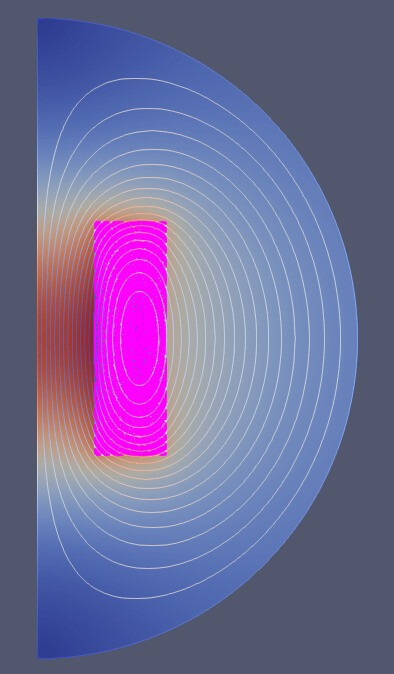
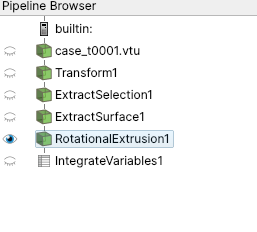
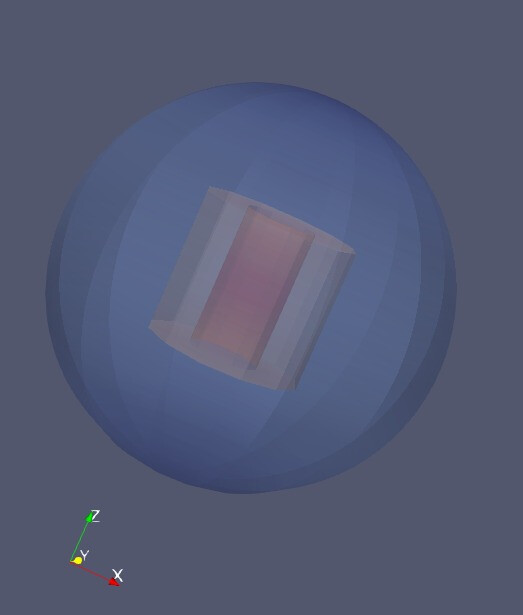
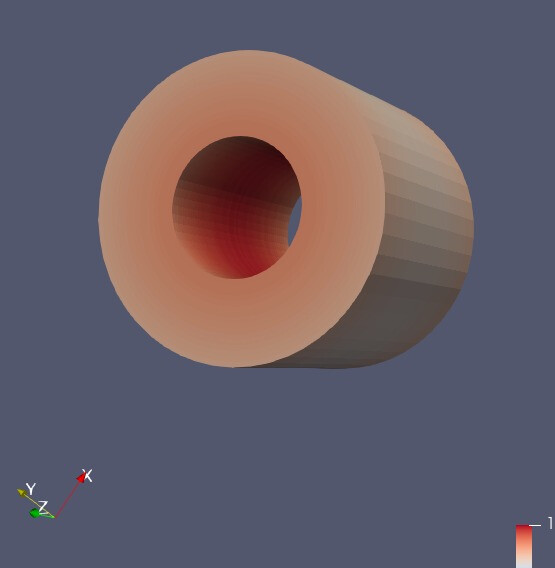
However, I still get the wrong integral result. Probably I’m not selecting the entire body?
Any suggestion?
---
### Author:  [@thalesmaoa](https://discourse.paraview.org/u/thalesmaoa)
#### Post date: [February 13, 2024, 7:51pm UTC](https://discourse.paraview.org/t/axis-symmetric-postprocessing/13889/4 "2024-02-13T19:51:21Z")
Is there a way to convert x,y to r,z?
---
### Author:  [@mwestphal](https://discourse.paraview.org/u/mwestphal)
#### Post date: [February 19, 2024, 9:40am UTC](https://discourse.paraview.org/t/axis-symmetric-postprocessing/13889/5 "2024-02-19T09:40:07Z")
If you know the axis of rotation, computing r and z should be trivial.
---
### Author:  [@thalesmaoa](https://discourse.paraview.org/u/thalesmaoa)
#### Post date: [February 19, 2024, 4:34pm UTC](https://discourse.paraview.org/t/axis-symmetric-postprocessing/13889/6 "2024-02-19T16:34:49Z")
Hi @mwestphal , I do know the axis of rotation. Can you give me a tip of how to calculate it?
---
### Author:  [@mwestphal](https://discourse.paraview.org/u/mwestphal)
#### Post date: [February 19, 2024, 4:37pm UTC](https://discourse.paraview.org/t/axis-symmetric-postprocessing/13889/7 "2024-02-19T16:37:06Z")
You should be able to find that on the internet without issues, here is one
> **[Polar coordinate system](https://en.wikipedia.org/wiki/Polar_coordinate_system)**
>
> In mathematics, the polar coordinate system is a two-dimensional coordinate system in which each point on a plane is determined by a distance from a reference point and an angle from a reference direction. The reference point (analogous to the origin of a Cartesian coordinate system) is called the pole, and the ray from the pole in the reference direction is the polar axis. The distance from the pole is called the radial coordinate, radial distance or simply radius, and the angle is called the an...
---
### Author:  [@thalesmaoa](https://discourse.paraview.org/u/thalesmaoa)
#### Post date: [February 19, 2024, 10:55pm UTC](https://discourse.paraview.org/t/axis-symmetric-postprocessing/13889/8 "2024-02-19T22:55:11Z")
Really sorry about the confusion. It is clear how to convert (mathematically speaking). However, it’s unclear how to manipulate coordinates in paraview. I can only view Variables Results.
I’m still learning paraview, the workflow and filters are not completely clear.
Should I use a specific filter or I should use calculator? If so, where can I see the list of available variables?
Thx
---
### Author:  [@mwestphal](https://discourse.paraview.org/u/mwestphal)
#### Post date: [February 20, 2024, 9:28am UTC](https://discourse.paraview.org/t/axis-symmetric-postprocessing/13889/9 "2024-02-20T09:28:51Z")
Hi @thalesmaoa
Indeed, Calculator and PythonCalculator should let you compute that easily
Best,