# Compute second order derivative of velocity
**URL:** https://discourse.paraview.org/t/compute-second-order-derivative-of-velocity/10593
**Category:** ParaView Support
**Created:** [October 25, 2022, 1:18pm UTC](https://discourse.paraview.org/t/compute-second-order-derivative-of-velocity/10593 "2022-10-25T13:18:51Z")
**Posts on this page:** 7
**Page:** 1
### Author:  [@Boone](https://discourse.paraview.org/u/Boone)
#### Post date: [October 25, 2022, 1:18pm UTC](https://discourse.paraview.org/t/compute-second-order-derivative-of-velocity/10593/1 "2022-10-25T13:18:51Z")
Hi everyone,
I am a new user of Paraview and I would like to compute the velocity gradient invariant for a channel flow simulation as well as quantities involving 2nd order velocity derivatives. For that reason I have to compute the 1st and 2nd order velocity derivatives.
I manage to compute them with the calculator filter one by one but I do not succeed in storing them in order to perform sums and products of these quantities: Q\_A=- \frac{1}{2} \left( \left( \frac{\partial u\_1}{\partial x\_1}\right)^2 +\left( \frac{\partial u\_2}{\partial x\_2}\right)^2+ 2\left( \frac{\partial u\_1}{\partial x\_2}\frac{\partial u\_2}{\partial x\_1}\right)\right).
Similarly, I would like to compute l= \frac{\frac{\partial u\_1}{\partial x\_1}}{\frac{\partial^2 u\_1}{\partial x\_1^2}}
Is it possible to compute these quantities with the programmable filter ? If yes, could you help me ? I do not find any example of the use of programmable filter to create new quantities.
Thanks,
Boone
---
### Author:  [@Christos\_Tsolakis](https://discourse.paraview.org/u/Christos_Tsolakis)
#### Post date: [October 25, 2022, 1:32pm UTC](https://discourse.paraview.org/t/compute-second-order-derivative-of-velocity/10593/2 "2022-10-25T13:32:10Z")
Hi @Boone and welcome to discourse!
In the calculator filter use the `Result Array Name` field to assign a name for the new variable. You can use this name in new calculator instances after that.
Alternatively here are some examples of using the programmable filter:
[https://docs.paraview.org/en/latest/ReferenceManual/pythonProgrammableFilter.html?highlight=programmable#understanding-the-programmable-modules](https://docs.paraview.org/en/latest/ReferenceManual/pythonProgrammableFilter.html?highlight=programmable#understanding-the-programmable-modules)
---
### Author:  [@Boone](https://discourse.paraview.org/u/Boone)
#### Post date: [October 25, 2022, 1:46pm UTC](https://discourse.paraview.org/t/compute-second-order-derivative-of-velocity/10593/3 "2022-10-25T13:46:58Z")
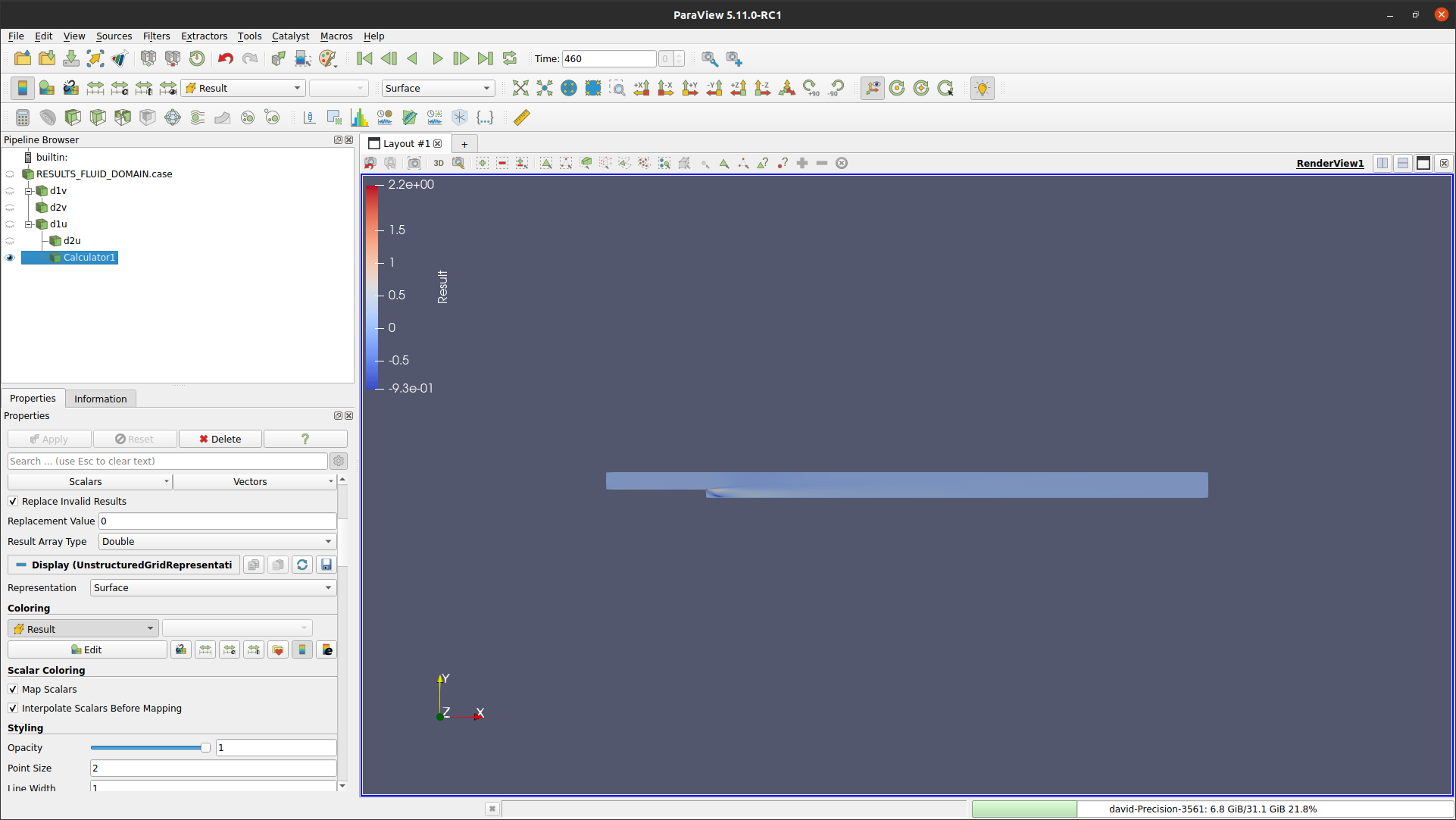
Thanks for your answer Christos. This is what I did but I do not find a way of computing the ratio between the 1st and 2nd order velocity since the calculator is only applied to 1 gradient block (see picture) I cannot use both the 1st and second order derivative in the same calculator. I have the same issue for the product between du1/dx2 and du2/dx1.
---
### Author:  [@Christos\_Tsolakis](https://discourse.paraview.org/u/Christos_Tsolakis)
#### Post date: [October 25, 2022, 1:55pm UTC](https://discourse.paraview.org/t/compute-second-order-derivative-of-velocity/10593/4 "2022-10-25T13:55:22Z")
The calculator(as any other filter) can see only variables in the same pipeline it belongs too.
In your case `d1v` and `d1u` are in different branches and thus have no knowledge of each other.
Try to add all of them in the same pipeline branch by selecting each time the previous as a source. This will allow to carry the results from previous computations into each calculator instance.
If you use the programmable filter you can have all these steps in a single filter. See figure 5.30 in the provided link.
---
### Author:  [@Kenneth\_Moreland](https://discourse.paraview.org/u/Kenneth_Moreland)
#### Post date: [October 25, 2022, 2:04pm UTC](https://discourse.paraview.org/t/compute-second-order-derivative-of-velocity/10593/5 "2022-10-25T14:04:27Z")
@Boone, have you tried using the `Gradient` filter? You can take the gradient of a vector field and get the 9-component second derivative. The `Gradient` filter is also capable of secondary values (such as divergence, vorticity, and Q criterion), which you can turn on with the advanced values.
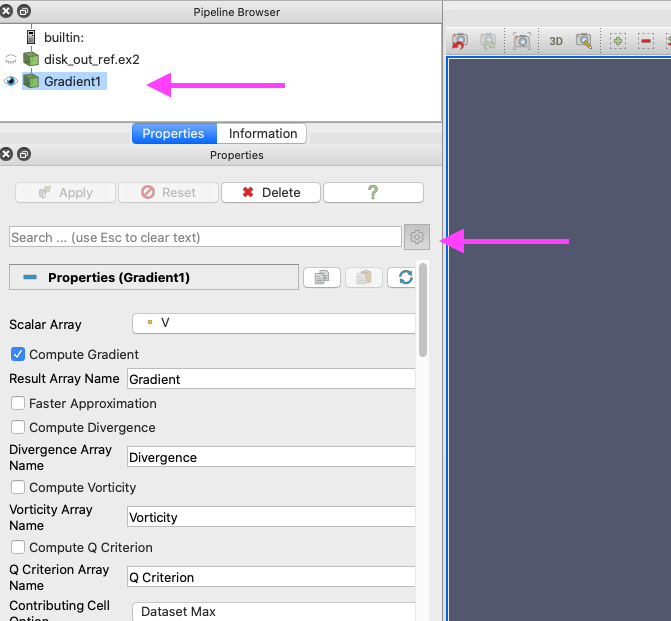
If that does not work, like @Christos_Tsolakis said, you can make both derivatives available in your pipeline by simply connecting the `d1u` filter to the `d2v` filter. This will make the outputs of both available at the same time (as long as you have unique `Result Array Name`s, as @Christos_Tsolakis also said). You could instead combine the output of the two calculators with the `Append Attributes` filter, but @Christos_Tsolakis’s solution is easier.
---
### Author:  [@Boone](https://discourse.paraview.org/u/Boone)
#### Post date: [October 25, 2022, 2:25pm UTC](https://discourse.paraview.org/t/compute-second-order-derivative-of-velocity/10593/6 "2022-10-25T14:25:52Z")
Thank you for your answers.
I managed to do it with the programmable filter:
```auto
input0=inputs[0]
U=input0.CellData["U_mean"]
gradu=gradient(U)
output.CellData.append(gradu, "du")
gradgradu=gradient(gradient(U))
output.CellData.append(gradgradu, "d2u")
V=input0.CellData["V_mean"]
gradv=gradient(V)
output.CellData.append(gradv, "dv")
gradgradv=gradient(gradient(V))
output.CellData.append(gradgradv, "d2v")
```
Do you know haw to extract the first component of the gradient of U directly in the programmable filter ? I tried :
```auto
l_VK=0.41*du_Y/"d2u_4"
output.CellData.append(l_VK, "l_VK")
```
and
```auto
l_VK=0.41*gradu[0]/"d2u_4"
output.CellData.append(l_VK, "l_VK")
```
but none of them works.
---
### Author:  [@Christos\_Tsolakis](https://discourse.paraview.org/u/Christos_Tsolakis)
#### Post date: [October 25, 2022, 2:56pm UTC](https://discourse.paraview.org/t/compute-second-order-derivative-of-velocity/10593/7 "2022-10-25T14:56:58Z")
> [@Boone](#):
>
> Do you know haw to extract the first component of the gradient of U directly in the programmable filter ? I tried :
You can use numpy 2D array slicing i.e.
```python
l_VK=0.41*gradu[:,0]
output.CellData.append(l_VK, "l_VK")
```
dividing with a string `"d2u_4"` is not going to work, make sure you define
`d2u_4` as a variable beforehand.