# Compute volume of 2D axisymmetric data
**URL:** https://discourse.paraview.org/t/compute-volume-of-2d-axisymmetric-data/5251
**Category:** ParaView Support
**Created:** [September 2, 2020, 8:45pm UTC](https://discourse.paraview.org/t/compute-volume-of-2d-axisymmetric-data/5251 "2020-09-02T20:45:48Z")
**Posts on this page:** 5
**Page:** 1
### Author:  [@woodscn](https://discourse.paraview.org/u/woodscn)
#### Post date: [September 2, 2020, 8:45pm UTC](https://discourse.paraview.org/t/compute-volume-of-2d-axisymmetric-data/5251/1 "2020-09-02T20:45:49Z")
I need to compute volumes for a 2-D cylindrical mesh of Cell Data, and I’m using V = 2_pi_r\*A, where A comes from the Cell Size filter. I can get something close using the Cell to Point filter, but that creates strange visual artifacts at the axis of rotation, probably because everything goes to zero there.
I found this work-around from @Kenneth_Moreland: [Add the cell center coordinates to the cell data](https://discourse.paraview.org/t/add-the-cell-center-coordinates-to-the-cell-data/560/2)
Is there a way this could be improved?
---
### Author:  [@woodscn](https://discourse.paraview.org/u/woodscn)
#### Post date: [September 2, 2020, 9:08pm UTC](https://discourse.paraview.org/t/compute-volume-of-2d-axisymmetric-data/5251/2 "2020-09-02T21:08:46Z")
The work-around has locked up paraview twice now, too, on the Append Attributes step, so it might not work anymore.
This is an AMR CTH dataset, if that’s relevant.
---
### Author:  [@woodscn](https://discourse.paraview.org/u/woodscn)
#### Post date: [September 4, 2020, 1:51am UTC](https://discourse.paraview.org/t/compute-volume-of-2d-axisymmetric-data/5251/3 "2020-09-04T01:51:13Z")
Perhaps something to do with an error I saw trying to apply the Group Datasets filter?
vtkMultiBlockDataSet (0x6a9bb40): vtkNonOverlappingAMR cannot be added as a block.
---
### Author:  [@woodscn](https://discourse.paraview.org/u/woodscn)
#### Post date: [September 9, 2020, 11:44pm UTC](https://discourse.paraview.org/t/compute-volume-of-2d-axisymmetric-data/5251/4 "2020-09-09T23:44:15Z")
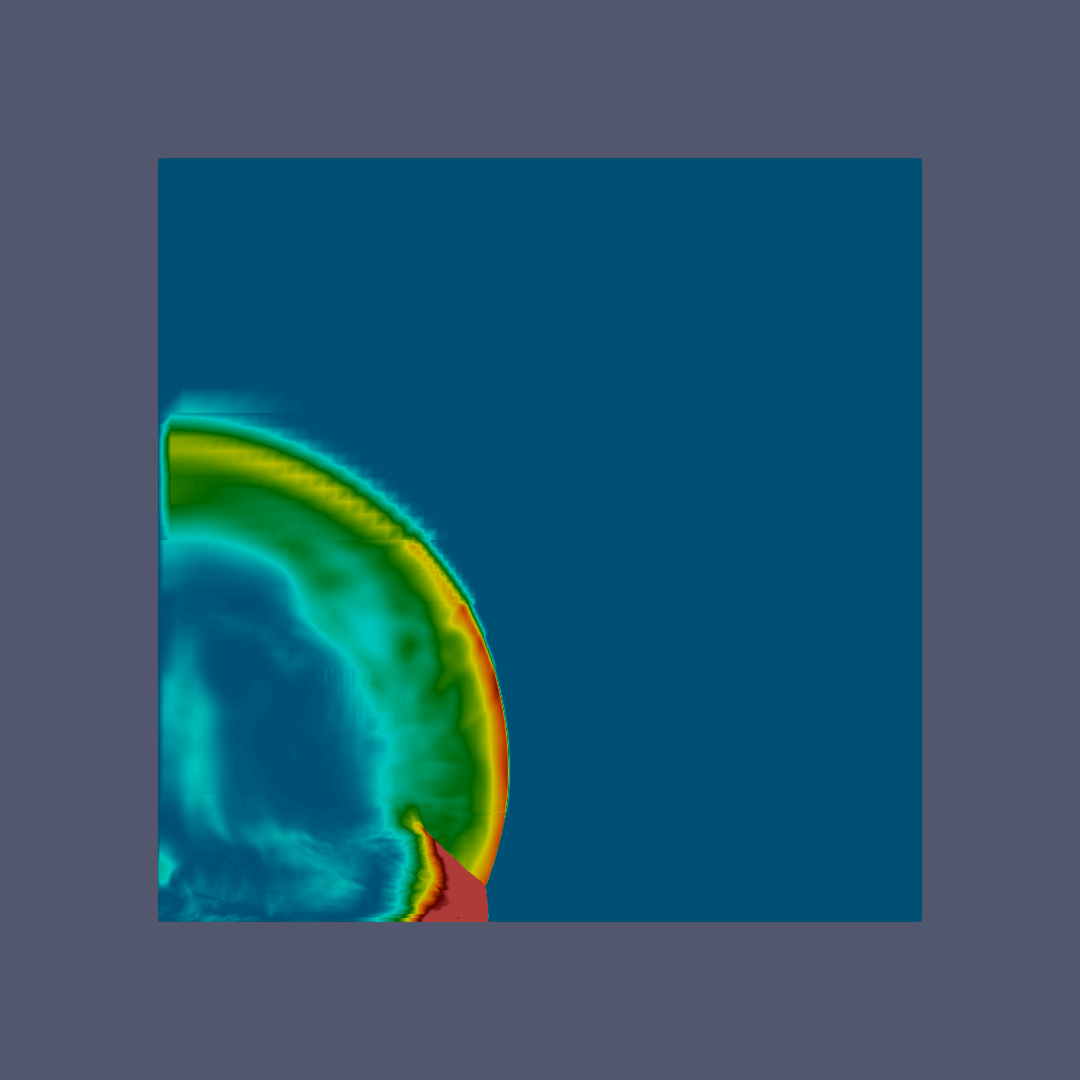
Note the blue line next to green on the left. That’s non-physical:
---
### Author:  [@woodscn](https://discourse.paraview.org/u/woodscn)
#### Post date: [September 12, 2020, 3:49pm UTC](https://discourse.paraview.org/t/compute-volume-of-2d-axisymmetric-data/5251/5 "2020-09-12T15:49:51Z")
This turns out to be much more straightforward than the previous work-around made it seem. Simply create a calculator for r = coordsX, then run a Point Data to Cell Data filter, to get the axisymmetric radius as a Cell Data field. Then, V = 2 \* pi \* A \* r.