# Cumulation values over time
**URL:** https://discourse.paraview.org/t/cumulation-values-over-time/10338
**Category:** ParaView Support
**Created:** [September 16, 2022, 10:25am UTC](https://discourse.paraview.org/t/cumulation-values-over-time/10338 "2022-09-16T10:25:16Z")
**Posts on this page:** 10
**Page:** 1
### Author:  [@Jonas](https://discourse.paraview.org/u/Jonas)
#### Post date: [September 16, 2022, 10:25am UTC](https://discourse.paraview.org/t/cumulation-values-over-time/10338/1 "2022-09-16T10:25:16Z")
Hi,
I would like to calculate and display total absolute value (cumulation) of displecement or strain over all timesteps. I found filter “integrate” is there similar one that would integrate over time? Or is there other way to do it?
Thank you,
Jonas
---
### Author:  [@Kenneth\_Moreland](https://discourse.paraview.org/u/Kenneth_Moreland)
#### Post date: [September 16, 2022, 1:34pm UTC](https://discourse.paraview.org/t/cumulation-values-over-time/10338/2 "2022-09-16T13:34:25Z")
The `Temporal Statistics` filter can compute the average of field values over all time. You could multiply the average by the number of time steps to get the sum.
I don’t know if there is an easier way to do it.
---
### Author:  [@Jonas](https://discourse.paraview.org/u/Jonas)
#### Post date: [September 19, 2022, 8:37am UTC](https://discourse.paraview.org/t/cumulation-values-over-time/10338/3 "2022-09-19T08:37:35Z")
Thanks for reply! Problem is that there is periodic change of temerature, that results in periodic strains, so average value will not represent the total value of strain…
---
### Author:  [@Kenneth\_Moreland](https://discourse.paraview.org/u/Kenneth_Moreland)
#### Post date: [September 19, 2022, 12:21pm UTC](https://discourse.paraview.org/t/cumulation-values-over-time/10338/4 "2022-09-19T12:21:44Z")
I guess I do not understand your question then. The `Integrate Variables` filter you reference in your initial question essentially just sums up all the field values in your dataset, and you said you wanted to do that over time instead of space. Now you are saying that you don’t want to just sum up the values over time. So, what are you trying to do?
---
### Author:  [@Jonas](https://discourse.paraview.org/u/Jonas)
#### Post date: [September 22, 2022, 12:16pm UTC](https://discourse.paraview.org/t/cumulation-values-over-time/10338/5 "2022-09-22T12:16:06Z")
Sorry, I guess I did not put it right. I want to cummulate value separately for each point over time, so the result would show the amount of strain, that each point went trought during the whole process.
I hope It is more understandable.
---
### Author:  [@Kenneth\_Moreland](https://discourse.paraview.org/u/Kenneth_Moreland)
#### Post date: [September 22, 2022, 2:00pm UTC](https://discourse.paraview.org/t/cumulation-values-over-time/10338/6 "2022-09-22T14:00:24Z")
I still do not understand. The `Temporal Statistics` filter does cumulate over time each point value separately.
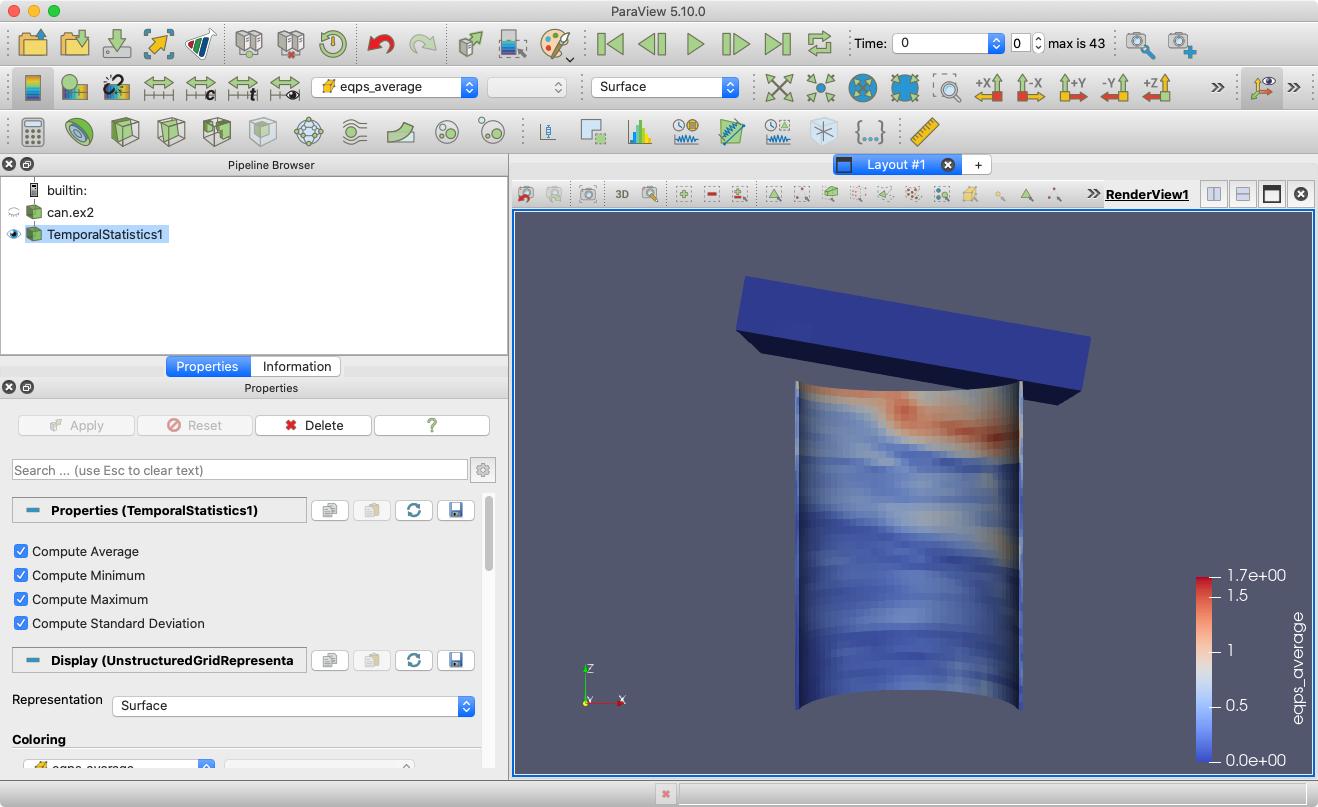
As an example, here is me running the `Temporal Statistics` filter on the `can.ex2` data set (one of the example data sets that comes with ParaView). It shows for each cell the equivalent plastic strain (eqps). The values are averaged over all time, but each value remains separate.
How does your problem differ?
---
### Author:  [@Jonas](https://discourse.paraview.org/u/Jonas)
#### Post date: [September 26, 2022, 10:07am UTC](https://discourse.paraview.org/t/cumulation-values-over-time/10338/7 "2022-09-26T10:07:38Z")
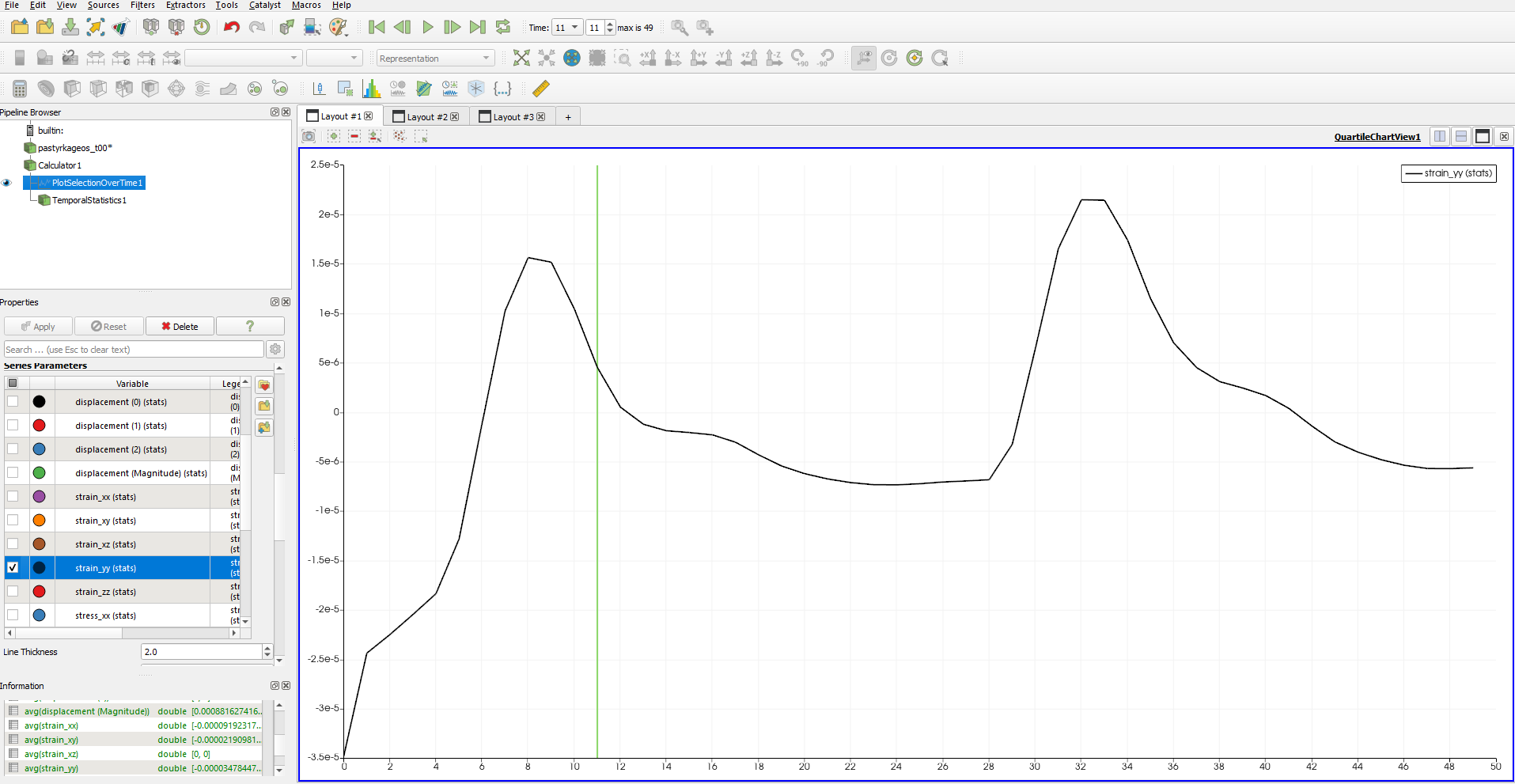
Sorry for late answers…I have perodical data, so the strain is not increasing all the time, but is oscilating around zero as seen on the Plot over time chart. I want to see the total distance (trajectory) or strain each cell went trough.
---
### Author:  [@Kenneth\_Moreland](https://discourse.paraview.org/u/Kenneth_Moreland)
#### Post date: [September 26, 2022, 12:24pm UTC](https://discourse.paraview.org/t/cumulation-values-over-time/10338/8 "2022-09-26T12:24:18Z")
I’m still not totally sure what you want. Are you saying that you want to compute the total _absolute_ strain so that positive and negative values of strain add up rather than cancel out? In that case, you can just use the `Calculator` filter to compute the absolute value of the strain (e.g., `abs(strain_yy)`) before running `Temporal Statistics`.
Or by total distance do you mean you are trying to find the length of the curve you plotted over time? That is more tricky, but should be possible.
---
### Author:  [@Jonas](https://discourse.paraview.org/u/Jonas)
#### Post date: [September 27, 2022, 10:29am UTC](https://discourse.paraview.org/t/cumulation-values-over-time/10338/9 "2022-09-27T10:29:26Z")
Its the first one, thank you. But I´ ll still have to use the average multiplied by timesteps right?
---
### Author:  [@Kenneth\_Moreland](https://discourse.paraview.org/u/Kenneth_Moreland)
#### Post date: [September 27, 2022, 12:35pm UTC](https://discourse.paraview.org/t/cumulation-values-over-time/10338/10 "2022-09-27T12:35:57Z")
Correct.