# Disconnected elements with unique nodal numbers
**URL:** https://discourse.paraview.org/t/disconnected-elements-with-unique-nodal-numbers/343
**Category:** ParaView Support
**Created:** [July 20, 2018, 8:23am UTC](https://discourse.paraview.org/t/disconnected-elements-with-unique-nodal-numbers/343 "2018-07-20T08:23:38Z")
**Posts on this page:** 5
**Page:** 1
### Author:  [@sujith.gowda](https://discourse.paraview.org/u/sujith.gowda)
#### Post date: [July 20, 2018, 8:23am UTC](https://discourse.paraview.org/t/disconnected-elements-with-unique-nodal-numbers/343/1 "2018-07-20T08:23:38Z")
Hallo,
I am trying to obtain a mesh as shown in the picture below, where the quad elements are not connected to each other and possess unique nodes.
Is it possible to generate these elements ? How to write it for VTK data ?
Please let me know,
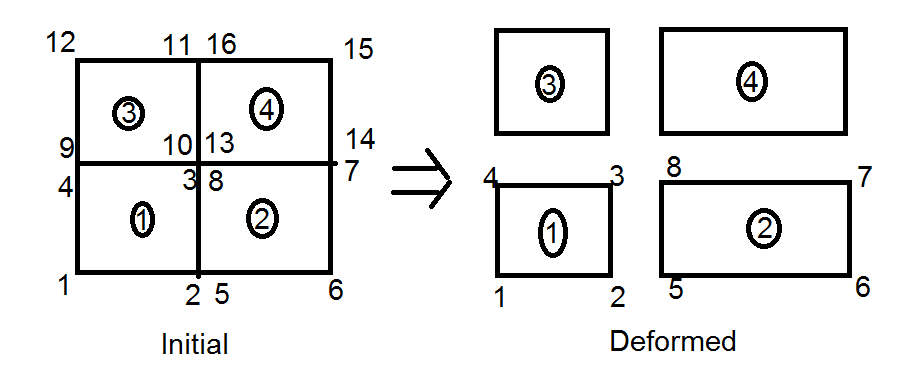
Thank you,
Sujith
---
### Author:  [@Michael](https://discourse.paraview.org/u/Michael)
#### Post date: [July 20, 2018, 9:13am UTC](https://discourse.paraview.org/t/disconnected-elements-with-unique-nodal-numbers/343/2 "2018-07-20T09:13:06Z")
Hi,
Try to use the filter “Shrink” with a shrink factor of 1.
It should do what you are looking for.
Best,
Michael
---
### Author:  [@sujith.gowda](https://discourse.paraview.org/u/sujith.gowda)
#### Post date: [July 20, 2018, 9:29am UTC](https://discourse.paraview.org/t/disconnected-elements-with-unique-nodal-numbers/343/3 "2018-07-20T09:29:45Z")
Thanks for your reply,
Shrink only made the conventional connected elements look separated.
But, I am writing the nodal data for these elements to move around freely.
For the given picture,
If I write number of points as 6 and elements as 4 with continuous connectivity (4 vertices quad (celltype - 9)); paraview reads it to create finite element mesh.
But I am writing 16 points to define the 4 elements which can move apart later (consider as in case of a crack). This fails to load in paraview and crashes without any error messages.
Thank you,
Sujith
---
### Author:  [@utkarsh.ayachit](https://discourse.paraview.org/u/utkarsh.ayachit)
#### Post date: [July 20, 2018, 1:42pm UTC](https://discourse.paraview.org/t/disconnected-elements-with-unique-nodal-numbers/343/4 "2018-07-20T13:42:38Z")
Here’s an ascii VTK file [four\_quads.vtk](https://discourse.paraview.org/uploads/default/original/1X/25f3d357427909749ff5f9771a4cfed80a609b3a.vtk) (932 Bytes). The quad elements/points order is slightly different, but this should get you give you the idea on how such a dataset can be constructed.
---
### Author:  [@sujith.gowda](https://discourse.paraview.org/u/sujith.gowda)
#### Post date: [July 24, 2018, 11:50am UTC](https://discourse.paraview.org/t/disconnected-elements-with-unique-nodal-numbers/343/5 "2018-07-24T11:50:41Z")
Thanks a lot, it helped me !
Its working for my dataset.
Sujith