# Extrapolate the Data to get Full Grid
**URL:** https://discourse.paraview.org/t/extrapolate-the-data-to-get-full-grid/9429
**Category:** ParaView Support
**Created:** [April 14, 2022, 8:57am UTC](https://discourse.paraview.org/t/extrapolate-the-data-to-get-full-grid/9429 "2022-04-14T08:57:14Z")
**Posts on this page:** 6
**Page:** 1
### Author:  [@Ekrem\_Ekici](https://discourse.paraview.org/u/Ekrem_Ekici)
#### Post date: [April 14, 2022, 8:57am UTC](https://discourse.paraview.org/t/extrapolate-the-data-to-get-full-grid/9429/1 "2022-04-14T08:57:14Z")
Hi,
I want to extrapolate my partial data to get full grid.
Here is the full Grid:
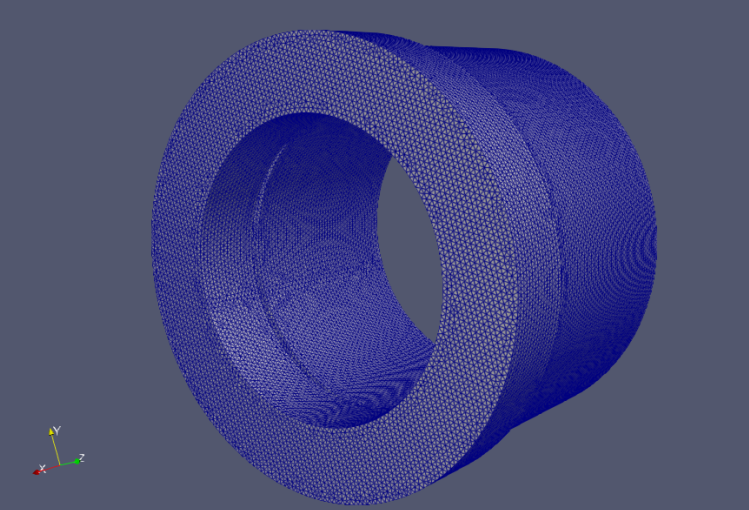
I want to get the full grid from the grid below;
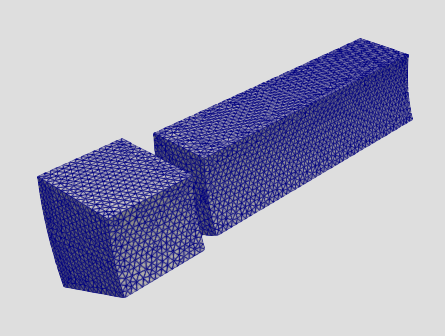
It is just 1/16th of the full grid. I need to copy and translate the partial grid by 16 times. But I couldn’t find any filter that might be useful for my problem?
Can you please help in this issue?
Thanks for your answer in advance.
---
### Author:  [@Kenneth\_Moreland](https://discourse.paraview.org/u/Kenneth_Moreland)
#### Post date: [April 14, 2022, 3:28pm UTC](https://discourse.paraview.org/t/extrapolate-the-data-to-get-full-grid/9429/2 "2022-04-14T15:28:59Z")
I don’t know of any way to do this automatically, but you can use the `Transform` filter to create a rotated copy of the data. Assuming that the X axis is the center of rotation, you can just rotate the source by factors of 22.5. You can then collect the 16 copies with a `GroupDatasets` filter and merge all the pieces together with a `MergeBlocks`.
This is tedious, but you can use python scripting to automate this. Here is an example script:
```auto
source = GetActiveSource()
all_pieces = [source]
for i in range(1, 16):
transform = Transform(Input=source)
transform.Transform.Rotate = [22.5 * i, 0, 0]
all_pieces.append(transform)
group = GroupDatasets(Input=all_pieces)
merge = MergeBlocks(Input=group)
Hide(source)
Show(merge)
```
You can access python scripting with the menu item `View` → `Python Shell`.
---
### Author:  [@Ekrem\_Ekici](https://discourse.paraview.org/u/Ekrem_Ekici)
#### Post date: [April 14, 2022, 5:48pm UTC](https://discourse.paraview.org/t/extrapolate-the-data-to-get-full-grid/9429/3 "2022-04-14T17:48:03Z")
Thank you very much Kenneth!
One more question, if I want to multiply this vector with some constant(depends on the theta) while rotation, how can I achieve that?
Many thanks!
---
### Author:  [@Kenneth\_Moreland](https://discourse.paraview.org/u/Kenneth_Moreland)
#### Post date: [April 14, 2022, 5:54pm UTC](https://discourse.paraview.org/t/extrapolate-the-data-to-get-full-grid/9429/4 "2022-04-14T17:54:03Z")
Sorry, I don’t understand what you mean by “this vector”. Are you referring to the `[22.5 * i, 0, 0]`? This is all just python, so use whatever syntax makes sense. If you want to make it easy to adjust the angle to rotate on, you could modify the script with something like this:
```auto
rotate_angle = 22.5
#...
transform.Transform.Rotate = [rotate_angle * i, 0, 0]
```
---
### Author:  [@Ekrem\_Ekici](https://discourse.paraview.org/u/Ekrem_Ekici)
#### Post date: [April 20, 2022, 12:00pm UTC](https://discourse.paraview.org/t/extrapolate-the-data-to-get-full-grid/9429/5 "2022-04-20T12:00:34Z")
Thanks for your reply, I should be more clear. I want to multiply first piece by e^{j \* 1 \* \theta} where \theta is 22.5 and j is unit imaginary number. Then rotate by 22.5 degree.
Next, multiply first piece by e^{j \* 2 \* \theta}, then rotate by 45 degree and so on to get full rotation.
How can I implement that? How can I scale the plot in python script?
Thanks for your answer in advance.
---
### Author:  [@Ekrem\_Ekici](https://discourse.paraview.org/u/Ekrem_Ekici)
#### Post date: [April 27, 2022, 2:09pm UTC](https://discourse.paraview.org/t/extrapolate-the-data-to-get-full-grid/9429/6 "2022-04-27T14:09:12Z")
@Kenneth_Moreland Could you please have a look ?