# Extrapolation of axisymmetric data
**URL:** https://discourse.paraview.org/t/extrapolation-of-axisymmetric-data/14396
**Category:** ParaView Support
**Created:** [April 12, 2024, 8:59pm UTC](https://discourse.paraview.org/t/extrapolation-of-axisymmetric-data/14396 "2024-04-12T20:59:40Z")
**Posts on this page:** 3
**Page:** 1
### Author:  [@Eric\_Delhez](https://discourse.paraview.org/u/Eric_Delhez)
#### Post date: [April 12, 2024, 8:59pm UTC](https://discourse.paraview.org/t/extrapolation-of-axisymmetric-data/14396/1 "2024-04-12T20:59:40Z")
I have results from a 2D axisymmetric simulation and would like to extrapolate this into 3D by rotation around the axis. The filters Rotational Extrusion or VolumeOfRevolution work well for scalar quantities but I can I rotate the velocity field ? The orientation of the initial vectors should change from one radial plane to the other…with for instance the X component transformed into the radial component but I cannot get such a result. Does any of you have experience with this problem ? Thank you in advance,
EJMD
---
### Author:  [@Kenichiro-Yoshimi](https://discourse.paraview.org/u/Kenichiro-Yoshimi)
#### Post date: [April 14, 2024, 12:41am UTC](https://discourse.paraview.org/t/extrapolation-of-axisymmetric-data/14396/2 "2024-04-14T00:41:48Z")
To transform vector data, such as velocity, you might need to use the `Python Calculator`, although this process can be cumbersome.
For instance, if you have an axisymmetric model on the x-z plane that needs to be rotated around the z-axis and converted into 3D, the vector data for **velocity** would need to be transformed using the `Python Calculator` as follows:
```python
from copy import deepcopy
import numpy as np
# Here, the vector array is assumed to be named velocity.
outputArray = deepcopy(velocity)
r = np.sqrt(points[:,0]**2 + points[:,1]**2)
ids = np.where(r>0)
outputArray[ids,0] = velocity[ids,0] * points[ids,0] / r[ids]
outputArray[ids,1] = velocity[ids,0] * points[ids,1] / r[ids]
return outputArray
```
A simple sample State file is attached below.
[axis\_sym.zip](https://discourse.paraview.org/uploads/short-url/yo7hkS38sdhy2hvy3mD9bbq1rk2.zip) (53.6 KB)
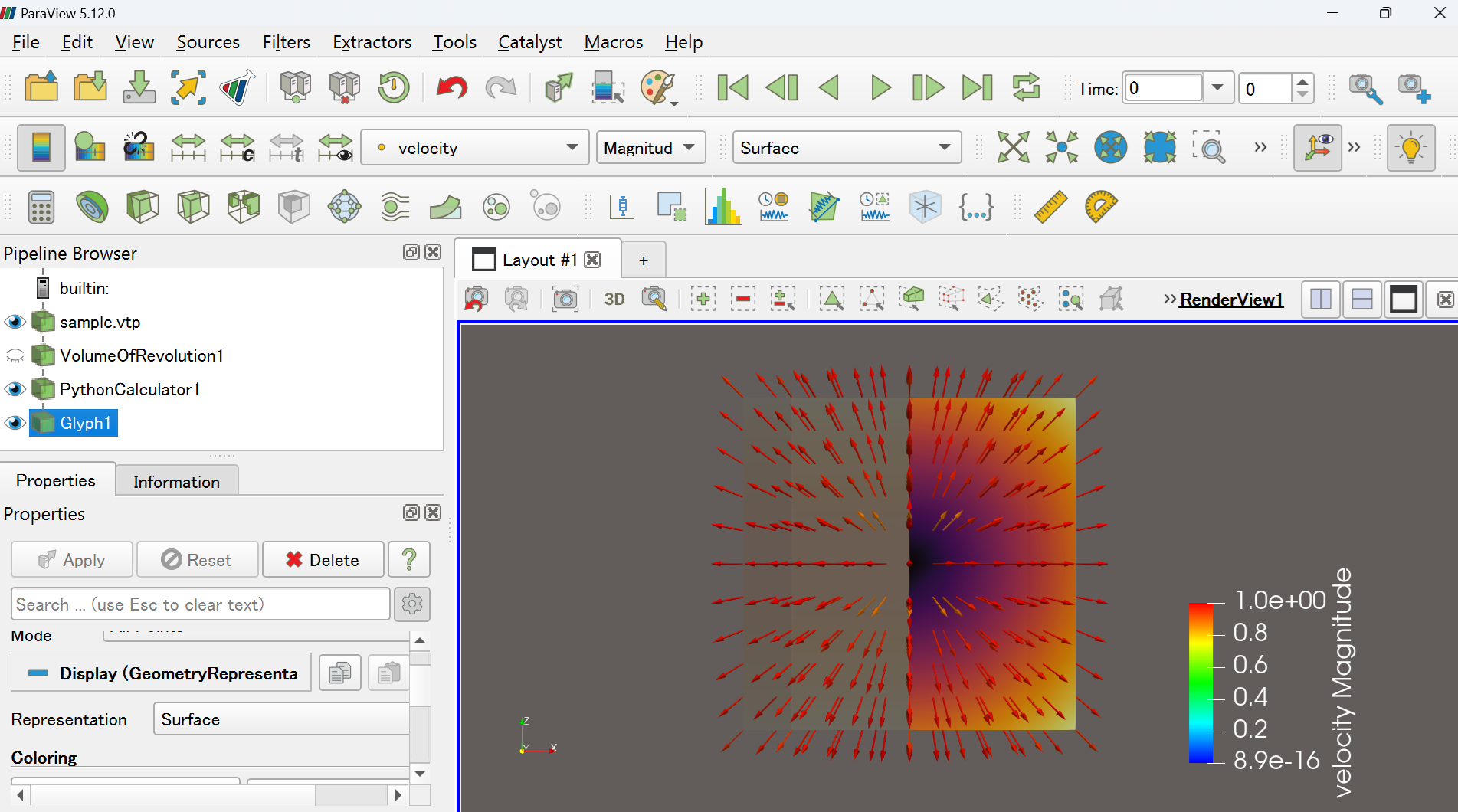
I hope this is useful to you.
---
### Author:  [@Eric\_Delhez](https://discourse.paraview.org/u/Eric_Delhez)
#### Post date: [April 24, 2024, 8:02pm UTC](https://discourse.paraview.org/t/extrapolation-of-axisymmetric-data/14396/3 "2024-04-24T20:02:09Z")
It is very helpful. Thanks a lot.
EJMD