# Fetch and Catalyst
**URL:** https://discourse.paraview.org/t/fetch-and-catalyst/9553
**Category:** In Situ Support
**Created:** [May 2, 2022, 3:13pm UTC](https://discourse.paraview.org/t/fetch-and-catalyst/9553 "2022-05-02T15:13:29Z")
**Posts on this page:** 7
**Page:** 1
### Author:  [@robertsawko](https://discourse.paraview.org/u/robertsawko)
#### Post date: [May 2, 2022, 3:13pm UTC](https://discourse.paraview.org/t/fetch-and-catalyst/9553/1 "2022-05-02T15:13:29Z")
I am getting some surprising behaviour in a code which is a bit hard to describe, so I just wanted to ask to double check my assumptions.
As per [my other posts](https://discourse.paraview.org/t/how-to-compute-contours-in-parallel/7046) I keep playing with computing connectivity in parallel. I compute in parallel some contours, run a Connectivity filter in ParaView (I am trying also `vtkPConnectivityFilter` in VTK through a programmable filter) and then feed into a Threshold filter, which I run through an Outline. All fun and games!
The result should be a `vtkPolyData` object that I want to store in a list for some additional processing on subsequent time steps. The problem I get in parallel runs is that data that are on other processors are inaccessible and I get bounding boxes of `-inf`, `inf` kind.
I am using `Fetch` to access the VTK object. In client-server mode `Fetch` gives you access to the output from a proxy and assembles the data on the client, but when I run Fetch in Catalyst I think I just get the VTK output visible to a given rank only. Is that correct?
Assuming that this is correct, I wrote a programmable filter with all the steps, but at the end I send everything to rank 0 through MPI controller. I confirm with print statements that my append filter has the correct bounding box. I still need to access this `vtkPolyData` so I run `Fetch` and somehow I get stuck with `inf`. I know that Fetch has a second argument which can take an integer, that will be interpreted as rank so I tried also
```python
myoutline = Fetch(self.programmable, arg2=0)
```
but that didn’t change anything.
My last question is a suspicion rather that I’d like confirmed. If Fetch runs on rank 0 will it return empty set if `arg=0`? I’ve gone through several iterations of this and it seems that now my problem is objects which are entirely on rank 0…
Alternatively, if you could advise what’s the best way in catalyst/pvpython in parallel to access and store a concatenated output of an outline filter/vtkPolyData that may be distributed over several ranks. I don’t mind it staying distributed or all going to rank 0 as long as I can store the copy of the output and compare with the future outputs of the same pipeline. I am doing a sort of feature tracking with `vtkPolyData` being tracked across time steps.
---
### Author:  [@Andy\_Bauer](https://discourse.paraview.org/u/Andy_Bauer)
#### Post date: [May 2, 2022, 3:23pm UTC](https://discourse.paraview.org/t/fetch-and-catalyst/9553/2 "2022-05-02T15:23:54Z")
I don’t know the exact answer to your question but a simple test should be trying to run `pvbatch` in parallel with the `-sym` command line option. This option results in each MPI process running the script and then `pvbatch` behaves very similarly to Catalyst when running Python scripts. Without the `-sym` argument only MPI process 0 actually runs the Python script and tells the other processes what to do, which is more like what happens in client-server mode.
This may not be the answer you’re looking for but is the way that I often debug Catalyst issues without having to actually run Catalyst.
---
### Author:  [@robertsawko](https://discourse.paraview.org/u/robertsawko)
#### Post date: [May 2, 2022, 3:29pm UTC](https://discourse.paraview.org/t/fetch-and-catalyst/9553/3 "2022-05-02T15:29:55Z")
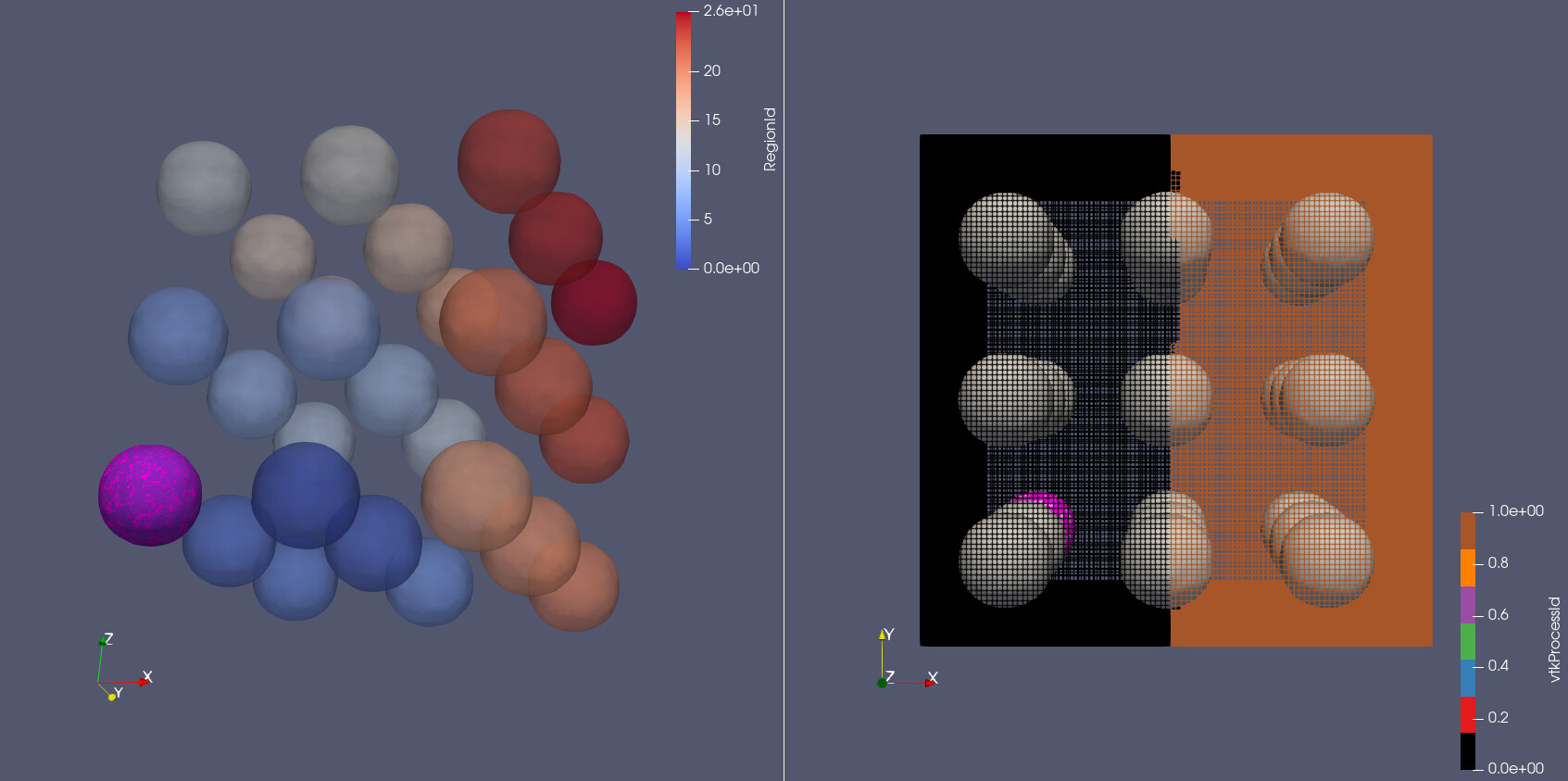
Sorry, I just want to add one picture to describe my problem better. Please see below.
I am testing on two processors and I have 27 balls. 9 on rank 0, 9 on rank 1 and 9 on the boundary. All I really want is to store their outlines somewhere and associated region ID and compare to the next time step.
The purple one is the one selected by Threshold. When I select the balls on rank 0 and Fetch the output I get `infs`. It seems to work fine for all balls that are not entirely on rank 0.
---
### Author:  [@robertsawko](https://discourse.paraview.org/u/robertsawko)
#### Post date: [May 2, 2022, 3:37pm UTC](https://discourse.paraview.org/t/fetch-and-catalyst/9553/4 "2022-05-02T15:37:36Z")
@Andy_Bauer, thanks for this. I will give it a shot.
---
### Author:  [@utkarsh.ayachit](https://discourse.paraview.org/u/utkarsh.ayachit)
#### Post date: [May 2, 2022, 4:55pm UTC](https://discourse.paraview.org/t/fetch-and-catalyst/9553/5 "2022-05-02T16:55:31Z")
Personally, I don’t care much for `Fetch`. It’s too confusing and very cryptic. `FetchData` added in 5.10, IIRC, is perhaps easier since it directly delivers data from ranks of interest. It also has options to indicate if data should be gathers on all ranks or just to root node – which may be good way of you want to build the cache on root node alone. `TestFetchData.py` has a few examples of how to use this function.
And as Andy mentioned, testing with `pvbatch --symmetric ... ` is indeed a good way to emulate Catalyst environment.
---
### Author:  [@robertsawko](https://discourse.paraview.org/u/robertsawko)
#### Post date: [May 2, 2022, 5:49pm UTC](https://discourse.paraview.org/t/fetch-and-catalyst/9553/6 "2022-05-02T17:49:52Z")
Thanks for this, @utkarsh.ayachit. Unfortunately, as I outlined [here](https://discourse.paraview.org/t/clean-installation-of-paraview-5-10-with-superbuild/9043/4) I am still struggling with recreating the same build with Catalyst on 5.10.x, but if you say that `FetchData` can sort out this problem, I will give it another go, presently.
I am just surprised that there is no other way to get a reference to VTK object. I understand `ProgrammableFilter` is a proxy, but we even specify `vtkPolyData` as output so I was looking for a clean way to get just that.
---
### Author:  [@utkarsh.ayachit](https://discourse.paraview.org/u/utkarsh.ayachit)
#### Post date: [May 2, 2022, 6:43pm UTC](https://discourse.paraview.org/t/fetch-and-catalyst/9553/7 "2022-05-02T18:43:41Z")
if all you care about is the locally produced dataset per rank, you can simply do the following:
```python
def get_local_data(producer):
# assuming pipeline is already updated
data = producer.GetClientSideObject().GetOutputDataObject(0)
clone = data.NewInstance()
clone.ShallowCopy(data)
return clone
...
myoutline = get_data(self.programmable)
```