# Field map rendering
**URL:** https://discourse.paraview.org/t/field-map-rendering/3798
**Category:** ParaView Support
**Created:** [March 12, 2020, 2:10pm UTC](https://discourse.paraview.org/t/field-map-rendering/3798 "2020-03-12T14:10:01Z")
**Posts on this page:** 6
**Page:** 1
### Author:  [@Sabrina](https://discourse.paraview.org/u/Sabrina)
#### Post date: [March 12, 2020, 2:10pm UTC](https://discourse.paraview.org/t/field-map-rendering/3798/1 "2020-03-12T14:10:01Z")
Dear all,
I have been using ParaView for visualizing the electric field map (geometry modeled with Gmsh and field solved with Elmerfem). My test case is just parallel disks with a certain voltage inside a box of air. Since the system is cylindrically symmetric I am just interested in seeing the field lines in 2D. For this I slice my cylinder with the homonym filter, plot the potential contour, then use the filter “Gradient of unstructured data set” (to calculate the E field, since what I actually have is the potential), and finally use the stream line tracer filter in the 2D plane that i chose.
Everything looks almost perfect, except for some strange lines originated in both plates, that have no physical meaning, and I don’t know what they are or how to get rid of. (see attached image)
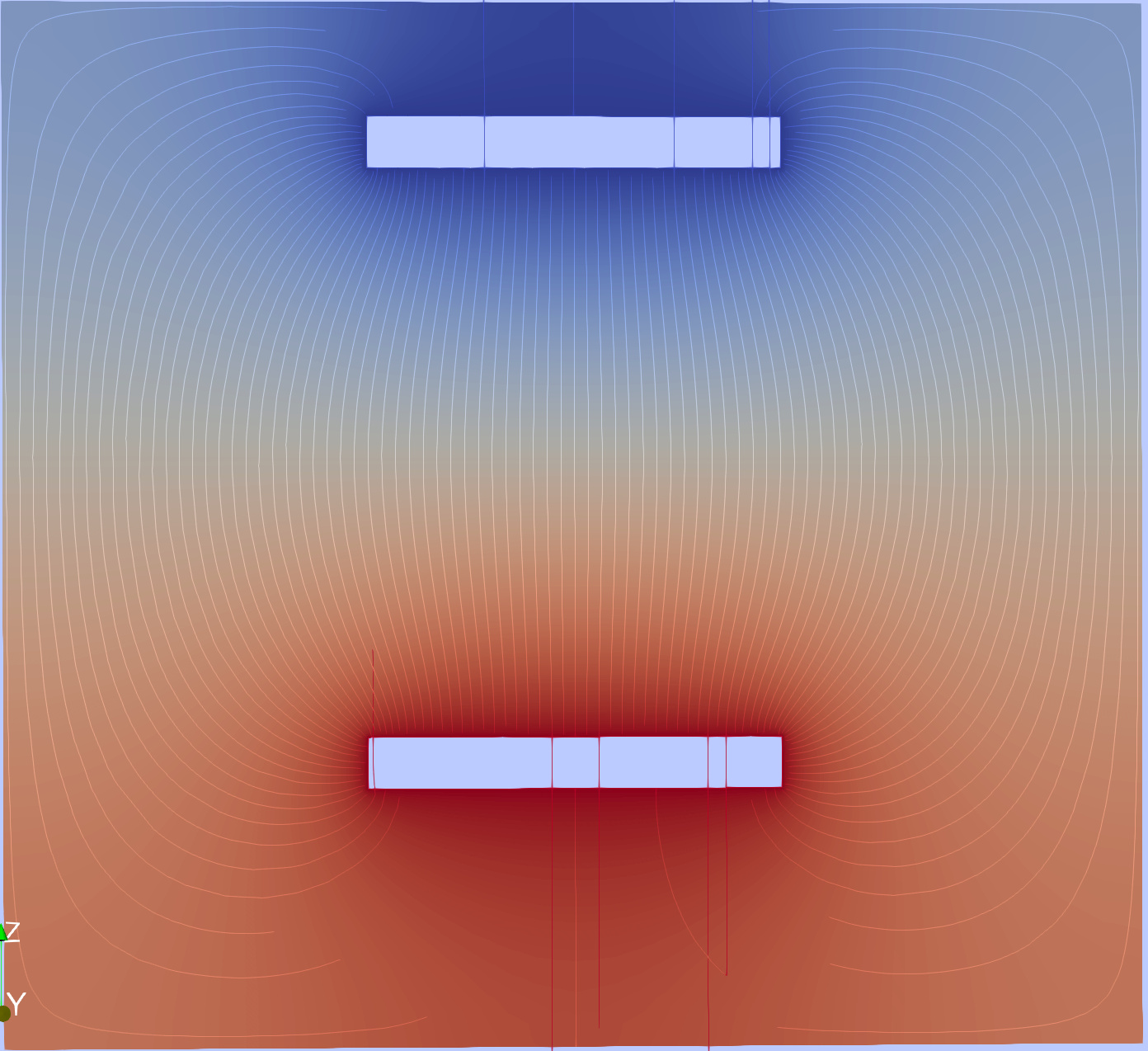
Does anyone know what is going on? I appreciate your comments.
Cheers!
Sabrina
---
### Author:  [@mwestphal](https://discourse.paraview.org/u/mwestphal)
#### Post date: [March 13, 2020, 3:09am UTC](https://discourse.paraview.org/t/field-map-rendering/3798/2 "2020-03-13T03:09:11Z")
Are you using Forward, Backward or both for the streamlines direction ?
---
### Author:  [@Sabrina](https://discourse.paraview.org/u/Sabrina)
#### Post date: [March 13, 2020, 2:46pm UTC](https://discourse.paraview.org/t/field-map-rendering/3798/3 "2020-03-13T14:46:34Z")
Hi Mathieu,
I am using Both directions
---
### Author:  [@mwestphal](https://discourse.paraview.org/u/mwestphal)
#### Post date: [March 16, 2020, 2:56am UTC](https://discourse.paraview.org/t/field-map-rendering/3798/4 "2020-03-16T02:56:44Z")
Does changing that helps ?
---
### Author:  [@Sabrina](https://discourse.paraview.org/u/Sabrina)
#### Post date: [March 16, 2020, 9:22am UTC](https://discourse.paraview.org/t/field-map-rendering/3798/5 "2020-03-16T09:22:19Z")
No, it does not. However, changing other parameters such as the integrator type , the step unit, min and max step length changes these lines, but they do not go away.
---
### Author:  [@mwestphal](https://discourse.paraview.org/u/mwestphal)
#### Post date: [March 18, 2020, 6:14am UTC](https://discourse.paraview.org/t/field-map-rendering/3798/6 "2020-03-18T06:14:03Z")
Could you share an example dataset ?