# how to access unknown blocks via python
**URL:** https://discourse.paraview.org/t/how-to-access-unknown-blocks-via-python/10667
**Category:** ParaView Support
**Created:** [November 3, 2022, 3:23pm UTC](https://discourse.paraview.org/t/how-to-access-unknown-blocks-via-python/10667 "2022-11-03T15:23:20Z")
**Posts on this page:** 3
**Page:** 1
### Author:  [@FerdiFuchs](https://discourse.paraview.org/u/FerdiFuchs)
#### Post date: [November 3, 2022, 3:23pm UTC](https://discourse.paraview.org/t/how-to-access-unknown-blocks-via-python/10667/1 "2022-11-03T15:23:20Z")
Hello everyone,
im digging here in the forum, but i cant get a working solution.
Im importing an ensight case and i want to access different patches of my cfd-domain to gain surface-averaged values of these patches depending on the patch name (for each outlet\*)
i know, i can extract these with extractblock and i know also about the syntax changes of extractblock for selecting these blocks from my vtkmultiblockdataset.
What i dont know, is the name of these blocks.
How can i retrieve, for example a list in python, with all the block names and maybe the case structure? Im really sorry, but i cant a working solution.
if i do the following:
```auto
...
ensightReader = EnSightReader(registrationName='ensightReader.case', CaseFileName='/path/to/ensight.case')
numberOfDataSets = ensightReader.GetDataInformation().DataInformation.GetNumberOfDataSets
print(numberOfDataSets)
```
it returns only 0
on the other hand, i know my case shows some hierarchical blocks:
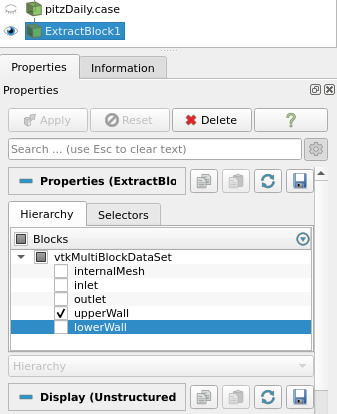
is someone here who can help me with this? im not very experienced with acessing paraview via python, but i learn quickly and i think the problem is really easy.
Allow me to point out, im just using the openfoam pitzdaily case as an minimal working example.
Thank you all very much.
---
### Author:  [@mwestphal](https://discourse.paraview.org/u/mwestphal)
#### Post date: [November 7, 2022, 7:05am UTC](https://discourse.paraview.org/t/how-to-access-unknown-blocks-via-python/10667/2 "2022-11-07T07:05:14Z")
Hi @FerdiFuchs ,
You need to use the DataInformation API:
[https://kitware.github.io/paraview-docs/latest/cxx/classpqOutputPort.html#a8e04d589198ebbb5da10ebfb7c97f2dc](https://kitware.github.io/paraview-docs/latest/cxx/classpqOutputPort.html#a8e04d589198ebbb5da10ebfb7c97f2dc)
That’s a starting point, do not hesitate if you need further help.
Best,
---
### Author:  [@FerdiFuchs](https://discourse.paraview.org/u/FerdiFuchs)
#### Post date: [November 7, 2022, 12:50pm UTC](https://discourse.paraview.org/t/how-to-access-unknown-blocks-via-python/10667/3 "2022-11-07T12:50:55Z")
Thanks @mwestphal ,
thats what i did. Sadly the the output told me, there are 0 blocks in my dataset, which is wrong (as displayed in the paraview picture).
But i found out during the weekend, that its important to call updatepipeline after reading the dataset:
```auto
UpdatePipeline(proxy=ensightReader)
```
Thanks for very much,
FerdiFuchs