# How to compute vorticity in Paraview
**URL:** https://discourse.paraview.org/t/how-to-compute-vorticity-in-paraview/4474
**Category:** ParaView Support
**Created:** [June 2, 2020, 1:09pm UTC](https://discourse.paraview.org/t/how-to-compute-vorticity-in-paraview/4474 "2020-06-02T13:09:41Z")
**Posts on this page:** 11
**Page:** 1
### Author:  [@ANON1](https://discourse.paraview.org/u/ANON1)
#### Post date: [June 2, 2020, 1:09pm UTC](https://discourse.paraview.org/t/how-to-compute-vorticity-in-paraview/4474/1 "2020-06-02T13:09:41Z")
I’ve opened the results of a simulation (Velocity field and Pressure) in Paraview. I know that the vorticity is by definition the curl of the velocity.
How can I proceed to to compute the vorticity in Paraview? I can’t find a clear answer to this after searching. Could you please give a detailed answer for someone beginner?
P.S: I am using a structured mesh for my domain, if that matters.
I appreciate your help.
---
### Author:  [@Kenneth\_Moreland](https://discourse.paraview.org/u/Kenneth_Moreland)
#### Post date: [June 2, 2020, 3:07pm UTC](https://discourse.paraview.org/t/how-to-compute-vorticity-in-paraview/4474/2 "2020-06-02T15:07:08Z")
You can compute vorticity using the `Gradient Of Unstructured DataSet` filter (it will work with structured data as well). After you add the filter, click on the gear icon  to toggle on advanced properties. From there you will see a `Compute Vorticity` option.
---
### Author:  [@PUC](https://discourse.paraview.org/u/PUC)
#### Post date: [February 27, 2023, 7:29pm UTC](https://discourse.paraview.org/t/how-to-compute-vorticity-in-paraview/4474/3 "2023-02-27T19:29:59Z")
> [@Kenneth\_Moreland](#):
>
> Gradient Of Unstructured DataSet
how can I install the filter “Gradient Of Unstructured DataSet”. I cannot find it in the filters section.
---
### Author:  [@cory.quammen](https://discourse.paraview.org/u/cory.quammen)
#### Post date: [February 27, 2023, 7:38pm UTC](https://discourse.paraview.org/t/how-to-compute-vorticity-in-paraview/4474/4 "2023-02-27T19:38:10Z")
That filter has been integrated into the main **Gradient** filter. You can use that instead.
---
### Author:  [@PUC](https://discourse.paraview.org/u/PUC)
#### Post date: [February 27, 2023, 8:36pm UTC](https://discourse.paraview.org/t/how-to-compute-vorticity-in-paraview/4474/5 "2023-02-27T20:36:56Z")
Thank you for the fast response. The problem is that in this filter there is no option to evaluate the Q-criterion
---
### Author:  [@cory.quammen](https://discourse.paraview.org/u/cory.quammen)
#### Post date: [February 27, 2023, 9:27pm UTC](https://discourse.paraview.org/t/how-to-compute-vorticity-in-paraview/4474/6 "2023-02-27T21:27:26Z")
The Q-criterion option is there:
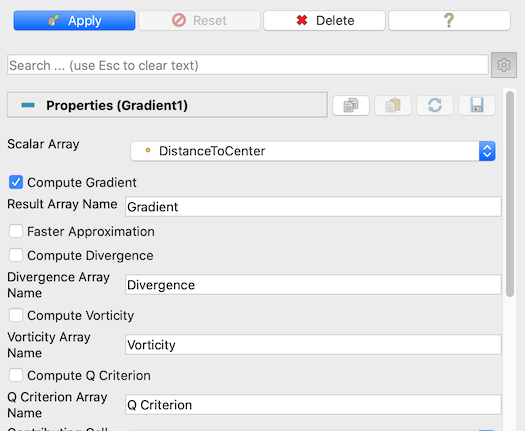
It’s an advanced property, so make sure the little gear icon in the upper right is toggled on.
---
### Author:  [@PUC](https://discourse.paraview.org/u/PUC)
#### Post date: [February 28, 2023, 8:13am UTC](https://discourse.paraview.org/t/how-to-compute-vorticity-in-paraview/4474/7 "2023-02-28T08:13:12Z")
Thank you for the help
---
### Author:  [@mar.premi](https://discourse.paraview.org/u/mar.premi)
#### Post date: [November 28, 2023, 9:23am UTC](https://discourse.paraview.org/t/how-to-compute-vorticity-in-paraview/4474/8 "2023-11-28T09:23:06Z")
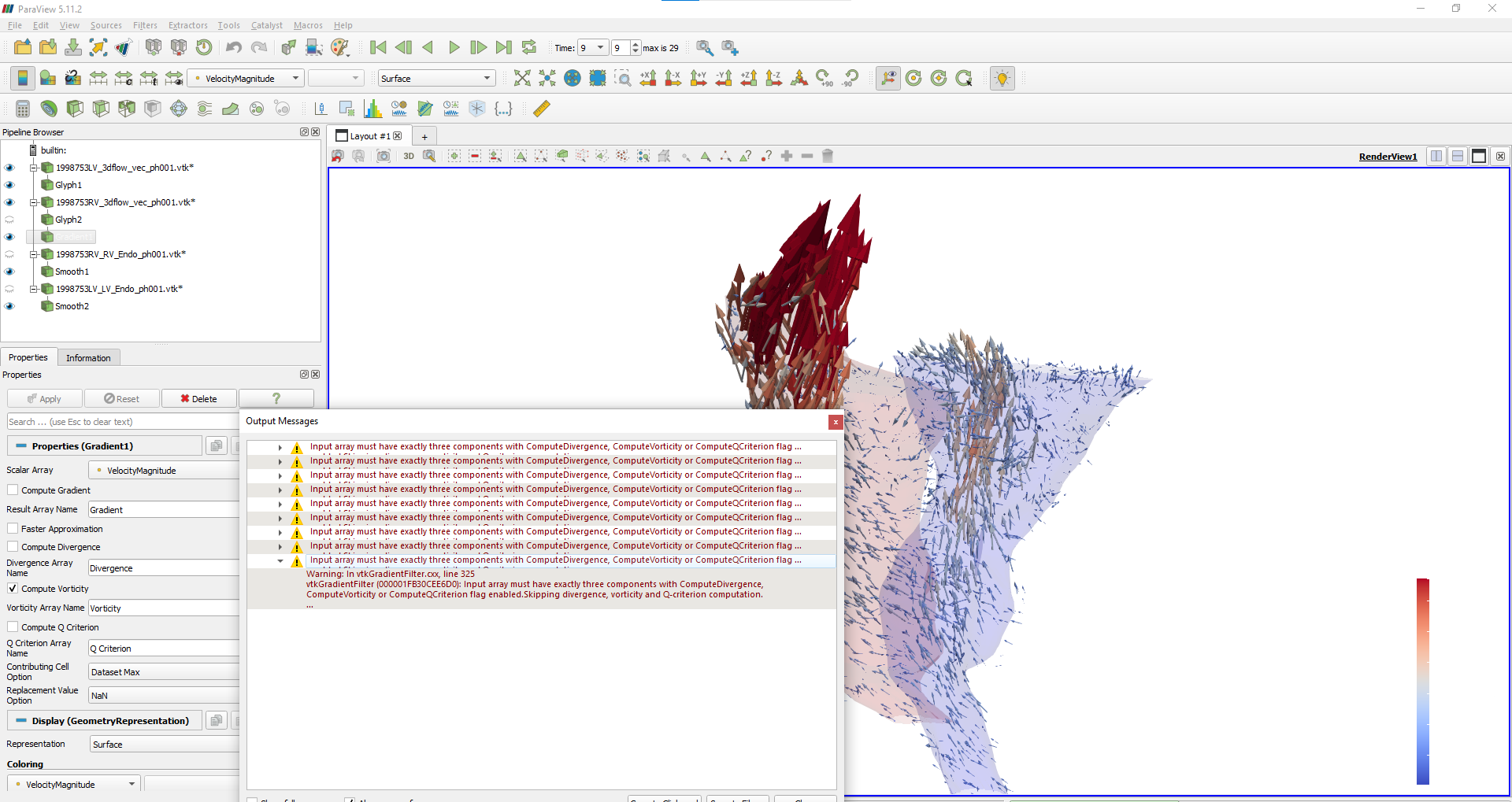
Can someone help me? I have a velocity field vtk dataset for RV and one for LV and I want to see the vorticity here!
---
### Author:  [@wascott](https://discourse.paraview.org/u/wascott)
#### Post date: [November 28, 2023, 5:22pm UTC](https://discourse.paraview.org/t/how-to-compute-vorticity-in-paraview/4474/9 "2023-11-28T17:22:12Z")
Hi Mar,
If I read your screenshot correctly, it looks like you are trying to use a magnitude (i.e., scalar) for a vector. Use a 3 component vector. See the information tab to see what variables are scalars and which are vectors. If you need to know how to create a vector from 3 scalars, see Help/ Classroom Tutorials/ Filters/ Calculator.
Alan
---
### Author:  [@mar.premi](https://discourse.paraview.org/u/mar.premi)
#### Post date: [December 11, 2023, 9:34am UTC](https://discourse.paraview.org/t/how-to-compute-vorticity-in-paraview/4474/10 "2023-12-11T09:34:39Z")
> [@Kenneth Moreland](#):
>
> radient Of Unstructured DataSet
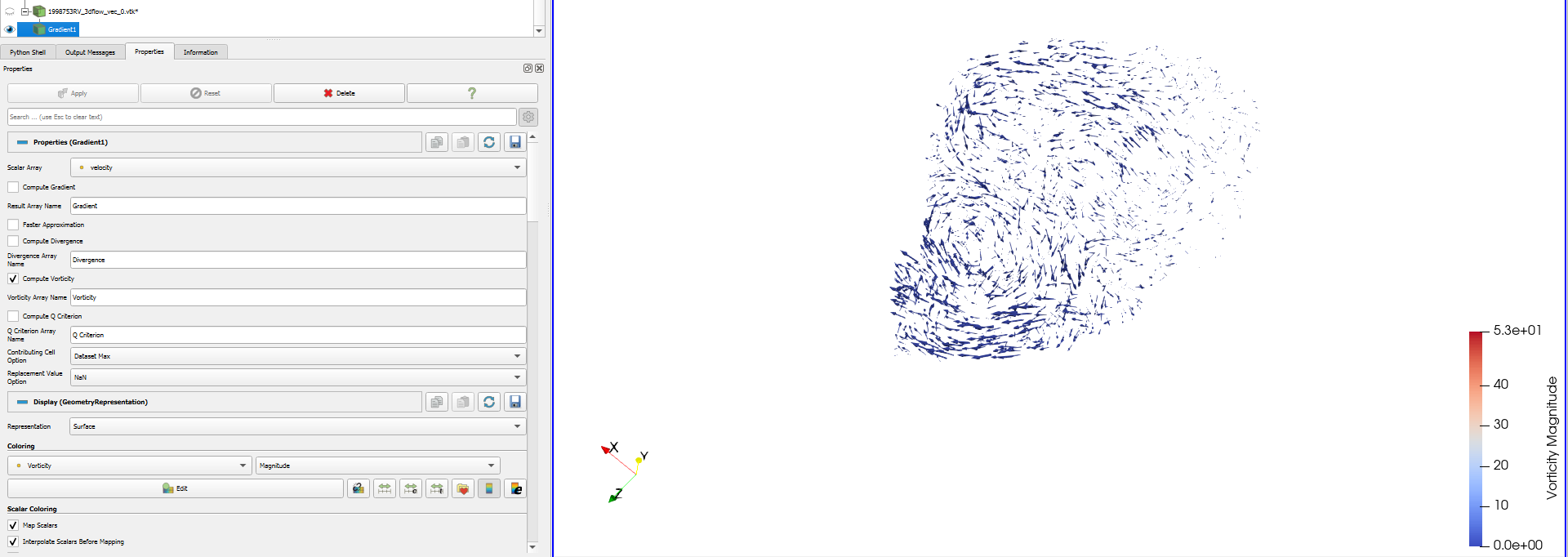
this is still the velocity field.
How can I calcualte vorticity? Can I do that in Python shell?
---
### Author:  [@mar.premi](https://discourse.paraview.org/u/mar.premi)
#### Post date: [December 11, 2023, 9:56am UTC](https://discourse.paraview.org/t/how-to-compute-vorticity-in-paraview/4474/11 "2023-12-11T09:56:04Z")
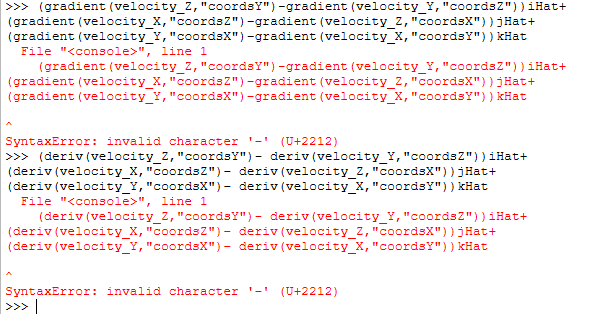
Also like this it doesn’t work