# How to create the surface of a point cloud object?
**URL:** https://discourse.paraview.org/t/how-to-create-the-surface-of-a-point-cloud-object/1051
**Category:** ParaView Support
**Created:** [December 17, 2018, 1:55am UTC](https://discourse.paraview.org/t/how-to-create-the-surface-of-a-point-cloud-object/1051 "2018-12-17T01:55:04Z")
**Posts on this page:** 7
**Page:** 1
### Author:  [@Dinushika1992](https://discourse.paraview.org/u/Dinushika1992)
#### Post date: [December 17, 2018, 1:55am UTC](https://discourse.paraview.org/t/how-to-create-the-surface-of-a-point-cloud-object/1051/1 "2018-12-17T01:55:04Z")
Hi,
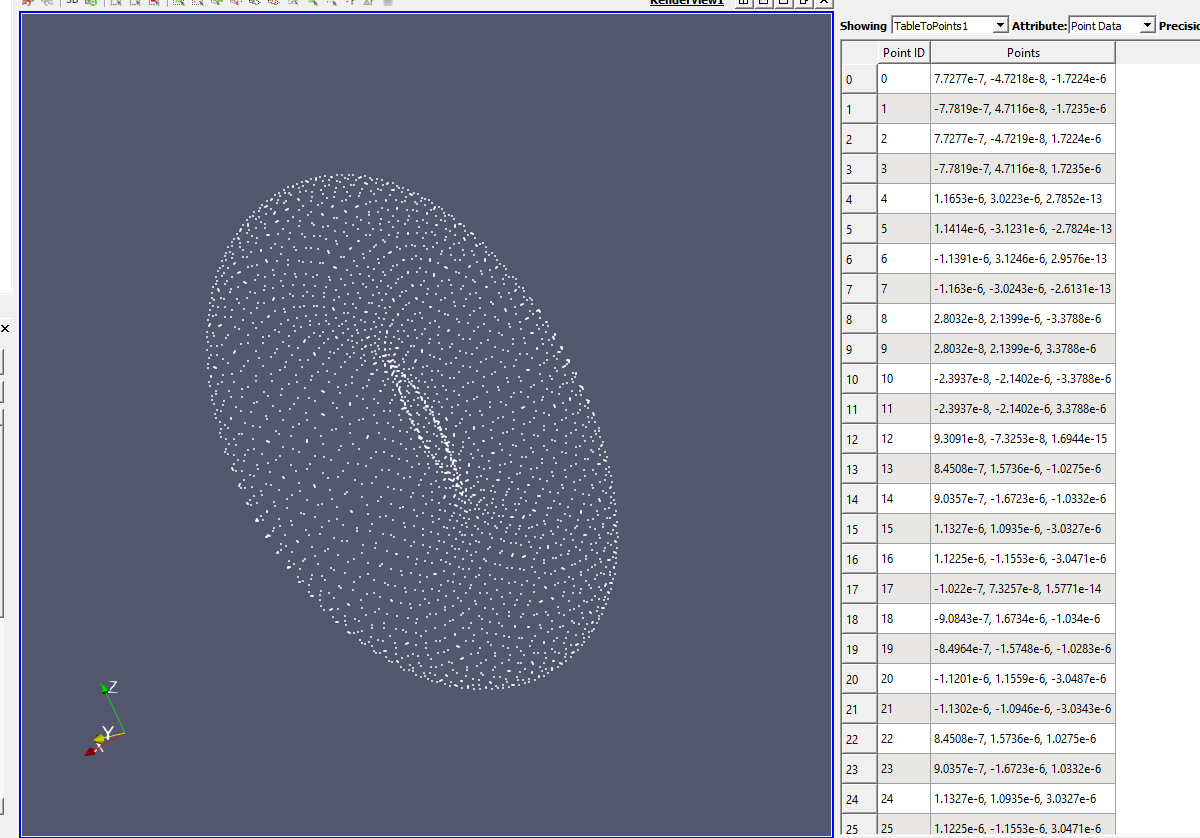
I have a point cloud object. I need to save it as a .stl file. But since there is no any surface of the object (there is only point data) I can not create a .stl file. Could you please help me to solve my problem?
---
### Author:  [@cory.quammen](https://discourse.paraview.org/u/cory.quammen)
#### Post date: [December 17, 2018, 2:28pm UTC](https://discourse.paraview.org/t/how-to-create-the-surface-of-a-point-cloud-object/1051/2 "2018-12-17T14:28:31Z")
ParaView has very limited tools for surface reconstruction from point clouds. You can apply the **Delaunay 3D** filter to create an unstructured mesh from the points and then extract the surface with the **Extract Surface** filter, but that works only if your object is convex.
---
### Author:  [@Dinushika1992](https://discourse.paraview.org/u/Dinushika1992)
#### Post date: [December 18, 2018, 12:58am UTC](https://discourse.paraview.org/t/how-to-create-the-surface-of-a-point-cloud-object/1051/3 "2018-12-18T00:58:16Z")
Dear Cory,
I tried this method. But it did not work for my case. Thank you very much.
---
### Author:  [@danlipsa](https://discourse.paraview.org/u/danlipsa)
#### Post date: [December 18, 2018, 3:48am UTC](https://discourse.paraview.org/t/how-to-create-the-surface-of-a-point-cloud-object/1051/4 "2018-12-18T03:48:13Z")
VTK Examples has some VTK external modules do this, but those operations need to be added to ParaView
[https://lorensen.github.io/VTKExamples/site/Cxx/Points/PoissonExtractSurface/](https://lorensen.github.io/VTKExamples/site/Cxx/Points/PoissonExtractSurface/)
---
### Author:  [@Pppp](https://discourse.paraview.org/u/Pppp)
#### Post date: [April 20, 2021, 10:57am UTC](https://discourse.paraview.org/t/how-to-create-the-surface-of-a-point-cloud-object/1051/5 "2021-04-20T10:57:39Z")
How can I calculate the distance between two 3D cloud points and how to view coincidence points between two surfaces.
---
### Author:  [@mwestphal](https://discourse.paraview.org/u/mwestphal)
#### Post date: [April 20, 2021, 12:43pm UTC](https://discourse.paraview.org/t/how-to-create-the-surface-of-a-point-cloud-object/1051/6 "2021-04-20T12:43:11Z")
Old topic is old, please open your own.
---
### Author:  [@mwestphal](https://discourse.paraview.org/u/mwestphal)
#### Post date: [April 20, 2021, 12:43pm UTC](https://discourse.paraview.org/t/how-to-create-the-surface-of-a-point-cloud-object/1051/7 "2021-04-20T12:43:14Z")