# Is there a way to generate the "same" streamlines so you can Track them in time?
**URL:** https://discourse.paraview.org/t/is-there-a-way-to-generate-the-same-streamlines-so-you-can-track-them-in-time/7237
**Category:** ParaView Support
**Created:** [May 15, 2021, 12:55pm UTC](https://discourse.paraview.org/t/is-there-a-way-to-generate-the-same-streamlines-so-you-can-track-them-in-time/7237 "2021-05-15T12:55:08Z")
**Posts on this page:** 6
**Page:** 1
### Author:  [@coreman](https://discourse.paraview.org/u/coreman)
#### Post date: [May 15, 2021, 12:55pm UTC](https://discourse.paraview.org/t/is-there-a-way-to-generate-the-same-streamlines-so-you-can-track-them-in-time/7237/1 "2021-05-15T12:55:08Z")
Hi there!
Is there any way one can “track” the same streamlines in different time\_files as you apply the same filter on different times?
Basically make an animation that tracks the “initial” fieldlines and see how they evolve in time.
---
### Author:  [@henry2004y](https://discourse.paraview.org/u/henry2004y)
#### Post date: [May 15, 2021, 6:20pm UTC](https://discourse.paraview.org/t/is-there-a-way-to-generate-the-same-streamlines-so-you-can-track-them-in-time/7237/2 "2021-05-15T18:20:13Z")
Streamlines are what we use to visualize fields, but they do not exist in nature. Think about how should we define the same field line at different times? I don’t think this is physically correct.
---
### Author:  [@mwestphal](https://discourse.paraview.org/u/mwestphal)
#### Post date: [May 17, 2021, 8:08am UTC](https://discourse.paraview.org/t/is-there-a-way-to-generate-the-same-streamlines-so-you-can-track-them-in-time/7237/3 "2021-05-17T08:08:57Z")
Use the ParticleTracer.
---
### Author:  [@coreman](https://discourse.paraview.org/u/coreman)
#### Post date: [May 17, 2021, 9:46am UTC](https://discourse.paraview.org/t/is-there-a-way-to-generate-the-same-streamlines-so-you-can-track-them-in-time/7237/4 "2021-05-17T09:46:51Z")
Thank you again for the replay.
So I should do what exactly? Generate a Source (say spherical source with wanted resolution) then give it as Seed, and input my Wanted vector? Then Stream with external source? If you could elaborate just a bit more 🙂
---
### Author:  [@mwestphal](https://discourse.paraview.org/u/mwestphal)
#### Post date: [May 17, 2021, 9:59am UTC](https://discourse.paraview.org/t/is-there-a-way-to-generate-the-same-streamlines-so-you-can-track-them-in-time/7237/5 "2021-05-17T09:59:00Z")
Here is webinar explaining how to use this filter. Starts at 32min.
[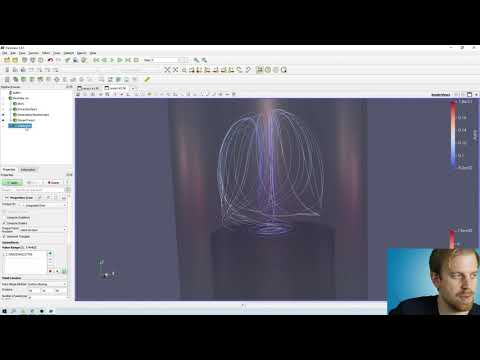 ](https://www.youtube.com/watch?v=7WMaHXLK6No)
---
### Author:  [@coreman](https://discourse.paraview.org/u/coreman)
#### Post date: [May 17, 2021, 11:35pm UTC](https://discourse.paraview.org/t/is-there-a-way-to-generate-the-same-streamlines-so-you-can-track-them-in-time/7237/6 "2021-05-17T23:35:13Z")
Hi Mathieu. So, sorry for asking again on the same topic. Solution is picked so it’s ok even if you dont answer. Video helped tons.
If I make this as a script, I can’t just “press” play and save the animation,I dont do this on Graphical environment cuz the files are on server.
Is there maybe a way to “secure” that the next file will “catch” the same particles?
Meaning that the way I make the scripts are : Generate a script → for i in range (data range).
But I’m thinking that this way it will “generate” every time new particles (via previous “algorithm”)