# OSPRay: dots in the images
**URL:** https://discourse.paraview.org/t/ospray-dots-in-the-images/1063
**Category:** ParaView Support
**Created:** [December 18, 2018, 10:15am UTC](https://discourse.paraview.org/t/ospray-dots-in-the-images/1063 "2018-12-18T10:15:44Z")
**Posts on this page:** 5
**Page:** 1
### Author:  [@Martin\_Larcher](https://discourse.paraview.org/u/Martin_Larcher)
#### Post date: [December 18, 2018, 10:15am UTC](https://discourse.paraview.org/t/ospray-dots-in-the-images/1063/1 "2018-12-18T10:15:44Z")
I have just discovered the newly introduced possibility in PV to use OSPRay for more realistic appearance. It looks really nice. Nevertheless, I have several white and red dots on my models, in particular in the window:
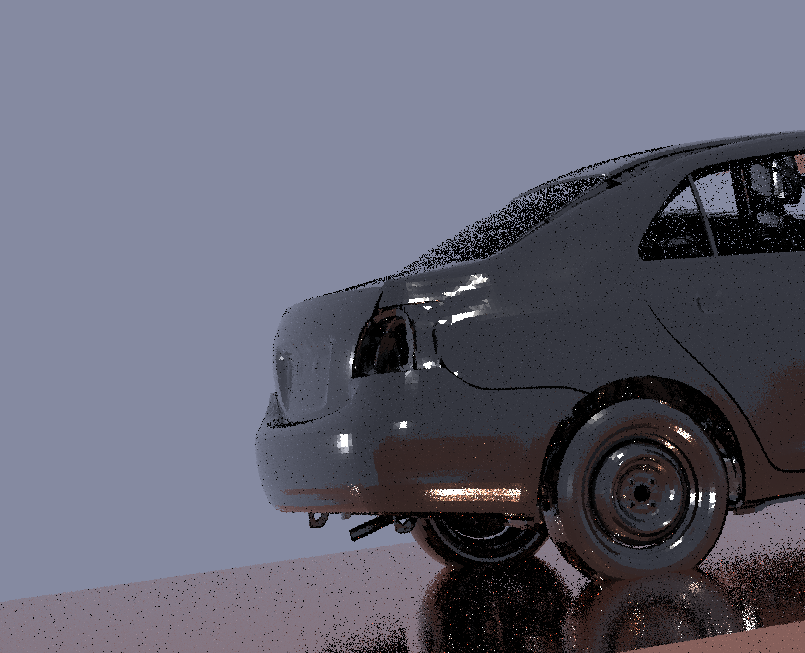
I see the same also on that example: [https://blog.kitware.com/kitware-talks-sc17-and-releases-for-vtk-paraview-and-cmake/](https://blog.kitware.com/kitware-talks-sc17-and-releases-for-vtk-paraview-and-cmake/)
Is there any reason for it and could it be removed? I’m using PV 5.6.0 under windows.
Many thanks
Martin
---
### Author:  [@Michael](https://discourse.paraview.org/u/Michael)
#### Post date: [December 18, 2018, 10:49am UTC](https://discourse.paraview.org/t/ospray-dots-in-the-images/1063/2 "2018-12-18T10:49:38Z")
Hi,
This is the _noise_ introduced by the renderer.
In order to remove this, increase the number of samples with the parameter `Samples Per Pixel`.
Be careful, it will increase the rendering time and freeze the UI until the rendering is complete.
In order to keep the UI interactive and see the image improving, launch ParaView with the option `--enable-streaming`.
---
### Author:  [@Martin\_Larcher](https://discourse.paraview.org/u/Martin_Larcher)
#### Post date: [December 18, 2018, 11:05am UTC](https://discourse.paraview.org/t/ospray-dots-in-the-images/1063/3 "2018-12-18T11:05:59Z")
Many thanks. That is the solution.
---
### Author:  [@GregVernon](https://discourse.paraview.org/u/GregVernon)
#### Post date: [January 5, 2019, 3:15pm UTC](https://discourse.paraview.org/t/ospray-dots-in-the-images/1063/4 "2019-01-05T15:15:33Z")
Michael,
I’ve noticed these spots show up on saved screenshots and is particularly annoying when the background (either of ParaView or in PowerPoint when using transparent background) appears throughout my rendered image. Is there any way to guarantee no spots? Maybe a “samples per pixel” : total pixels relationship?
---
### Author:  [@cory.quammen](https://discourse.paraview.org/u/cory.quammen)
#### Post date: [January 5, 2019, 5:30pm UTC](https://discourse.paraview.org/t/ospray-dots-in-the-images/1063/5 "2019-01-05T17:30:22Z")
There isn’t a way to guarantee no noise that I’m aware of, but stay tuned for further developments aimed at reducing this noise.