# Paraview files of flow simulations with 82 million particles available in a shared repository
**URL:** https://discourse.paraview.org/t/paraview-files-of-flow-simulations-with-82-million-particles-available-in-a-shared-repository/8150
**Category:** Announcements
**Created:** [October 10, 2021, 11:35am UTC](https://discourse.paraview.org/t/paraview-files-of-flow-simulations-with-82-million-particles-available-in-a-shared-repository/8150 "2021-10-10T11:35:22Z")
**Posts on this page:** 13
**Page:** 1
### Author:  [@Watermotion](https://discourse.paraview.org/u/Watermotion)
#### Post date: [October 10, 2021, 11:35am UTC](https://discourse.paraview.org/t/paraview-files-of-flow-simulations-with-82-million-particles-available-in-a-shared-repository/8150/1 "2021-10-10T11:35:23Z")
The ParaView files of flow simulations using 1, 5, 20 and 82 million **particles** are available from a research data repository under a plain CC BY license. I imagined that the community of ParaView developers and users may find pre-computed datasets with 82M particles useful for benchmarking the performance/robustness of their visualization and data-analysis algorithms.
The flow is a so-called **dam break** : a block of still water is allowed to slide and hits a wall at some distance downstream. Interestingly, the flow features a first stage where the trajectories are smooth and orderly, and a second when the motion is definitely chaotic after countless rebounds and splashes. (The simulations have been carried out with a particle-based method called SPH for Smoothed Particle Hydrodynamics.)
Please have a look at the **YouTube playlist** for a first visual appreciation: [The 2D dam-break benchmark dataset • SPH solutions - YouTube](https://www.youtube.com/playlist?list=PLb_klyJ6w5QihDlztSqN0GRhT7awNnibe). Note that, for your convenience, each video has a detailed explanation of its content, context and purpose. (Of course: all has been rendered in ParaView!)
The datasets contain, for each particle count, the 201 vtk files showed in the playlist animations. These files are available from the certified repository **4TU.ResearchData** in the Netherlands. You can visit it via the link below:
> **[High-resolution SPH simulations of a 2D dam-break flow against a vertical wall](https://data.4tu.nl/collections/_/5353691/1)**
>
> This collection contains simulations at four spatial resolutions of the benchmark solution of the 2D dam break impinging against a vertical wall used by D.D. Meringolo, S. Marrone, A. Colagrossi and Y. Liu. See "A dynamic δ-SPH model: how to get rid...
If you are interested, the following navigation tips can be handy.
- The **collection** where you land groups five **datasets**.
- One ‘gateway’ dataset contains all information needed to decide what to do with it next. In particular a **Commentary.pdf** document explains the origin and architecture of the collection.
- Then, the other data sets contain the files at the different particle counts (1, 5, 20, 82 millions): there you find a **compressed vtk file** for each frame with a consistent naming WaterParticle\_???.vtk.xz
- The total size of the collection is 735GB and consists of 1650 files. You can download either entire datasets or individual files.
I recommend to read the Commentary first.
I hope that sharing these large datasets can be useful also from the perspective of post-processing.
Giordano Lipari
---
### Author:  [@mwestphal](https://discourse.paraview.org/u/mwestphal)
#### Post date: [October 11, 2021, 8:50am UTC](https://discourse.paraview.org/t/paraview-files-of-flow-simulations-with-82-million-particles-available-in-a-shared-repository/8150/2 "2021-10-11T08:50:34Z")
This is invaluable @Watermotion , many thanks for sharing !
---
### Author:  [@Francois\_Mazen](https://discourse.paraview.org/u/Francois_Mazen)
#### Post date: [October 11, 2021, 9:07am UTC](https://discourse.paraview.org/t/paraview-files-of-flow-simulations-with-82-million-particles-available-in-a-shared-repository/8150/3 "2021-10-11T09:07:56Z")
Thanks a lot for sharing!
---
### Author:  [@Watermotion](https://discourse.paraview.org/u/Watermotion)
#### Post date: [October 13, 2021, 11:08am UTC](https://discourse.paraview.org/t/paraview-files-of-flow-simulations-with-82-million-particles-available-in-a-shared-repository/8150/4 "2021-10-13T11:08:07Z")
I am pleased that it is helpful.
If this community uses Twitter as well, this legacy tweet contains the announcement and links:
>
(Sorry I forgot the hashtag **#RenderedInParaView** then!)
The postdoc project that generated this collection is finished in the meantime and that Twitter account is not maintained any longer.
---
### Author:  [@Cristian24](https://discourse.paraview.org/u/Cristian24)
#### Post date: [October 13, 2021, 1:02pm UTC](https://discourse.paraview.org/t/paraview-files-of-flow-simulations-with-82-million-particles-available-in-a-shared-repository/8150/5 "2021-10-13T13:02:48Z")
Thanks a lot!
I tried loading all the vtk files (low res case) into Paraview but get a reading error. Does it require any specific plugin to load the files?
---
### Author:  [@mwestphal](https://discourse.paraview.org/u/mwestphal)
#### Post date: [October 13, 2021, 1:13pm UTC](https://discourse.paraview.org/t/paraview-files-of-flow-simulations-with-82-million-particles-available-in-a-shared-repository/8150/6 "2021-10-13T13:13:13Z")
I’m able to read the file here.
---
### Author:  [@Watermotion](https://discourse.paraview.org/u/Watermotion)
#### Post date: [October 14, 2021, 7:36am UTC](https://discourse.paraview.org/t/paraview-files-of-flow-simulations-with-82-million-particles-available-in-a-shared-repository/8150/7 "2021-10-14T07:36:42Z")
@Cristian24 Thanks for raising a flag. No plugin is needed.
Please note that the vtk files in the repository are compressed: decompressing the xz file into native vtk format should not be difficult (see Section 3.3.5 of the Commentary for tips). The compression pass also added the information to perform a file integrity control at the point of decompressing. So, once you manage to decompress successfully, the file is guaranteed to be the original.
If you met an exception nonetheless, would you please mention which specific file gave you hard time? There is a small but nonzero possibility that the file transfer from the compute node to the data repository resulted in an undetected corrupted copy. This might have corrupted the xz file and/or its vtk content. It would be helpful to record if this happened.
I hope this helps.
---
### Author:  [@Cristian24](https://discourse.paraview.org/u/Cristian24)
#### Post date: [October 14, 2021, 9:07am UTC](https://discourse.paraview.org/t/paraview-files-of-flow-simulations-with-82-million-particles-available-in-a-shared-repository/8150/8 "2021-10-14T09:07:41Z")
Actually I solved the problem by copying all the files in one folder. The error comes when I try to load all the folders containing the vtk files.
---
### Author:  [@mwestphal](https://discourse.paraview.org/u/mwestphal)
#### Post date: [October 28, 2021, 3:06pm UTC](https://discourse.paraview.org/t/paraview-files-of-flow-simulations-with-82-million-particles-available-in-a-shared-repository/8150/9 "2021-10-28T15:06:30Z")
Hi @Watermotion , the data seems to not be available anymore.
---
### Author:  [@Watermotion](https://discourse.paraview.org/u/Watermotion)
#### Post date: [November 1, 2021, 4:37pm UTC](https://discourse.paraview.org/t/paraview-files-of-flow-simulations-with-82-million-particles-available-in-a-shared-repository/8150/10 "2021-11-01T16:37:09Z")
@mwestphal Sorry for the late reply. The repository offers a deposit time of about five to ten years, anyhow order of magnitude larger than this incident. Perhaps it was a temporary outage. Have you tried again afterwards? If you still bump into the issue, please forward me the offending link (to a document that you do not manage to download) and I will ask the data librarians.
---
### Author:  [@mwestphal](https://discourse.paraview.org/u/mwestphal)
#### Post date: [November 1, 2021, 5:03pm UTC](https://discourse.paraview.org/t/paraview-files-of-flow-simulations-with-82-million-particles-available-in-a-shared-repository/8150/11 "2021-11-01T17:03:44Z")
Seems to work now, indeed.
---
### Author:  [@Watermotion](https://discourse.paraview.org/u/Watermotion)
#### Post date: [December 16, 2021, 10:28am UTC](https://discourse.paraview.org/t/paraview-files-of-flow-simulations-with-82-million-particles-available-in-a-shared-repository/8150/12 "2021-12-16T10:28:35Z")
This integration is for the viewers who already used the dataset collection and found that its commentary had needed another round of polish.
**Commentary.pdf** is the recommended entry document to familiarize oneself with the collection’s origin, purpose and organization.
The authors felt a lot of sympathy for that point of view, have embraced their mistakes and **published a completely revised version** of the document at [[0] SPH simulations of a 2D dam-break flow against a vertical wall. General information on the collection](https://data.4tu.nl/articles/dataset/_0_SPH_simulations_of_a_2D_dam-break_flow_against_a_vertical_wall_General_information_on_the_collection/14309240/2?file=31810985)
The reading experience should be friendlier. The document’s structure and message remain the same.
---
### Author:  [@Watermotion](https://discourse.paraview.org/u/Watermotion)
#### Post date: [June 17, 2022, 5:55pm UTC](https://discourse.paraview.org/t/paraview-files-of-flow-simulations-with-82-million-particles-available-in-a-shared-repository/8150/13 "2022-06-17T17:55:19Z")
Those who found this collection of datasets relevant for developing visualization and analysis tools, may also be interested in browsing a conference paper that discusses and illustrates them from a content-based perspective.
This conference paper is open-access under a CC-BY license from [Dam Break Flow Benchmarks: Quo Vadis? | Zenodo](https://doi.org/10.5281/zenodo.6391457). Also relevant for this community, the figures created with ParaView are shared open-access separately.
In particular, every point in the datasets contains values of velocity, density and an element identifier. You surely do not need to go into the science behind that.
However, the image shows
that all fields sometimes contain voids;
that velocity fields contain vortices (green-shaded pictures);
that density fields can contain reflected circular waves and impulses (brown-shaded pictures);
and, finally, that the identifier fields display different degrees of mixing between neighbouring elements.
These special features can provide useful test cases to develop pattern-identification algorithms and measures of (dis)order, I imagine.

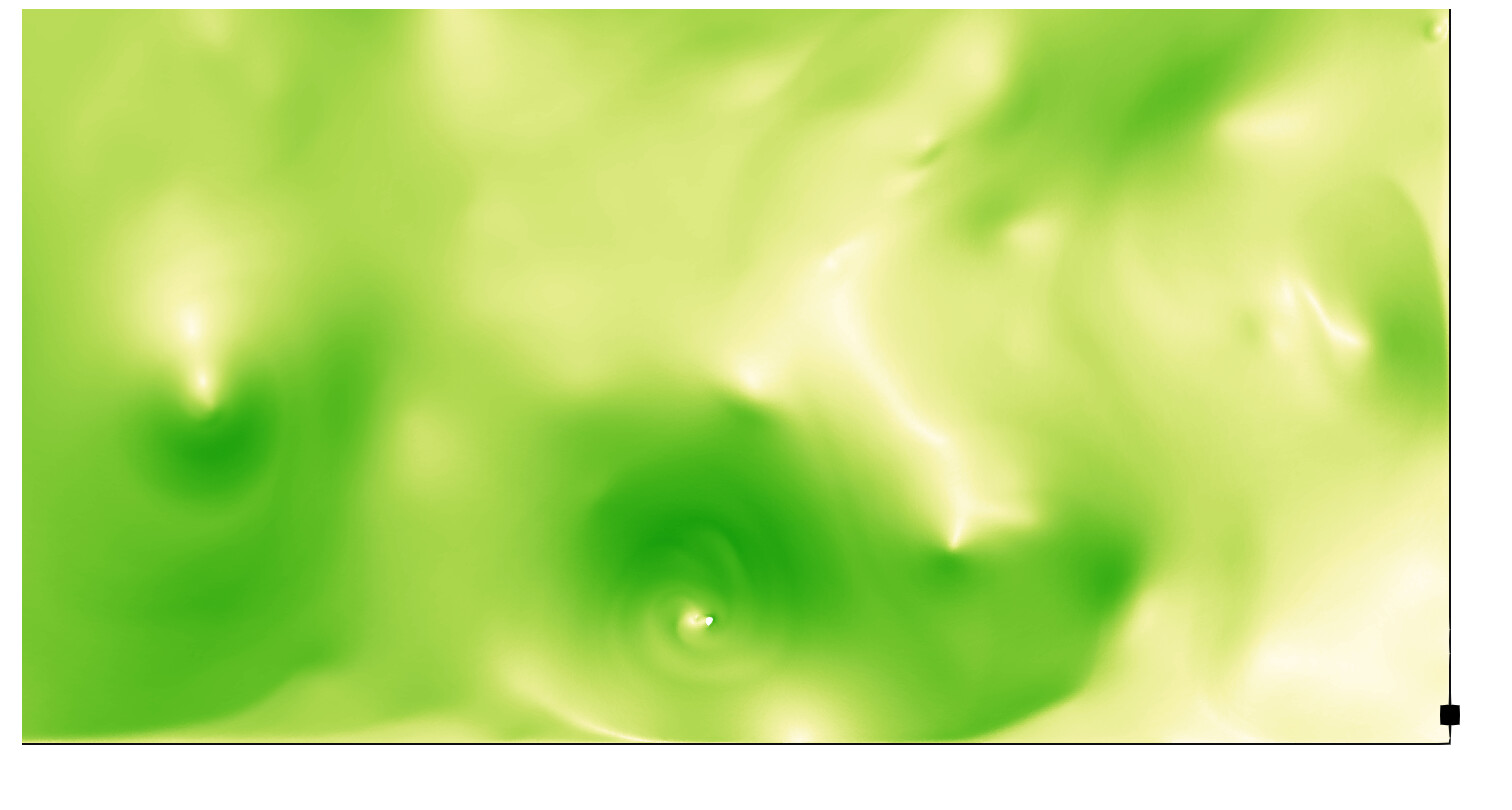
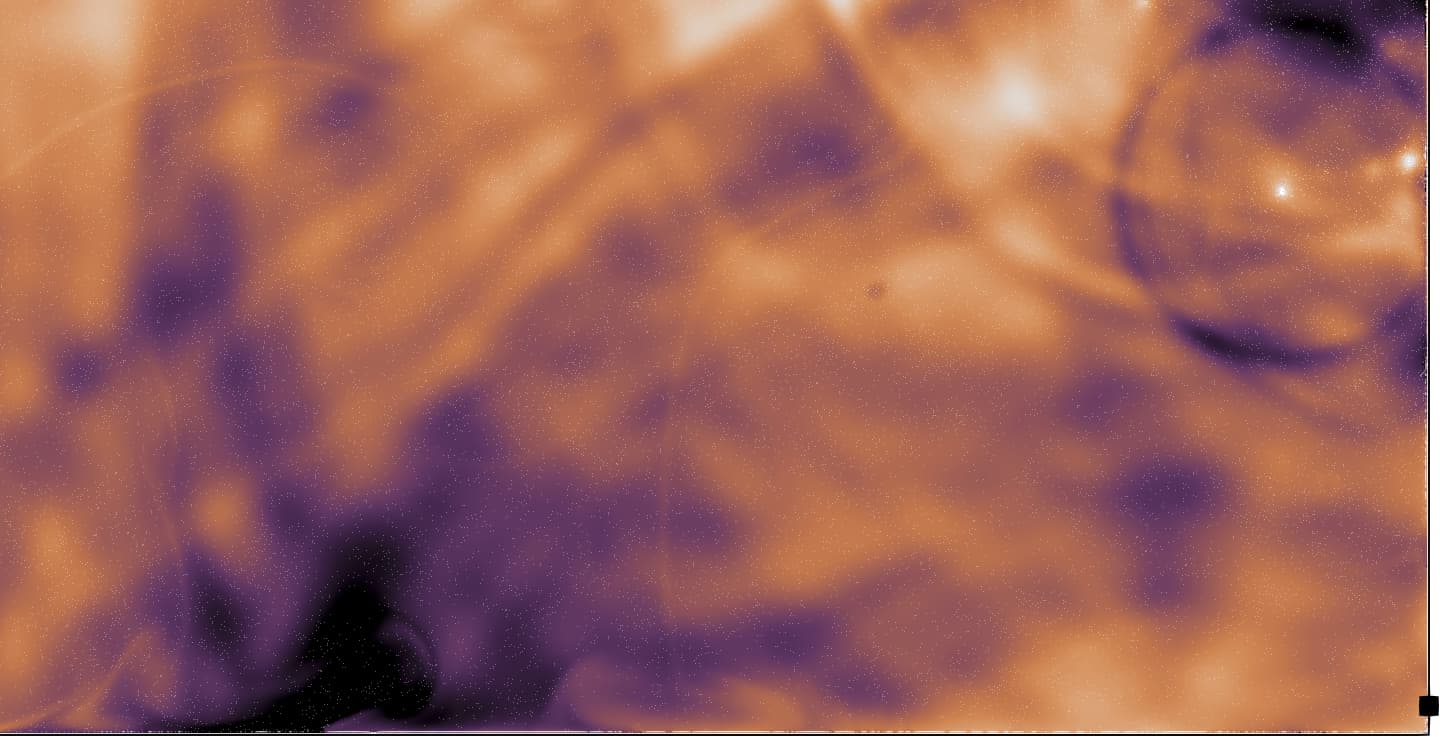

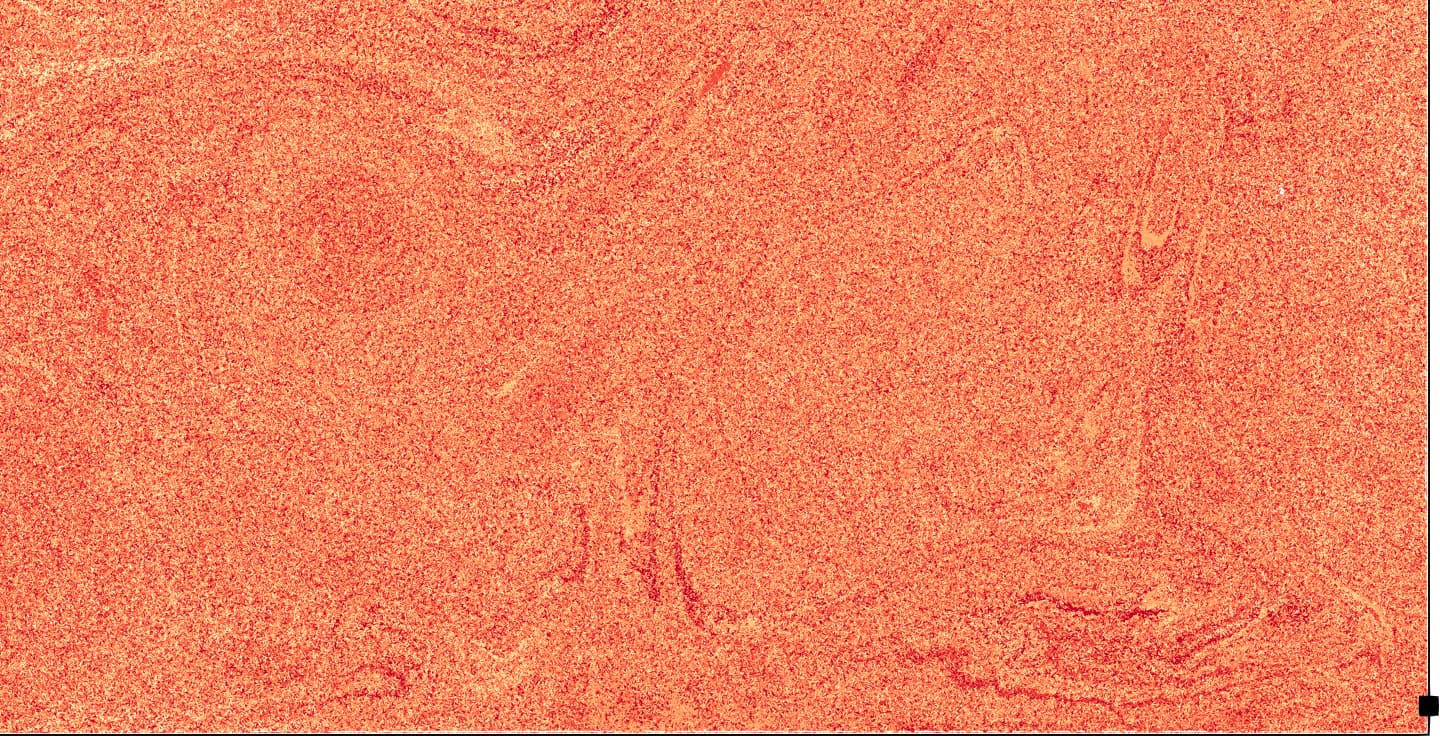

Hope this can help.
Kindly, Giordano Lipari