### Author:  [@M1kol4j](https://discourse.paraview.org/u/M1kol4j)
#### Post date: [September 17, 2023, 11:16am UTC](https://discourse.paraview.org/t/processing-very-large-vtkmultiblockdataset-performance-pipeline-suggestions-working-example-attached/12879/1 "2023-09-17T11:16:47Z")
Dear ParaView experts,
**Context:** I am working on a very large astrophysical simulation. Our parallel code splits the computational domain into hundreds of thousands of small, independent, structured grids (typical size `24^3` gridpoints). In one variant of that simulation setup, these meshes are slightly tilted with respect to each other (see first figure). This is to cover the surface of the star.
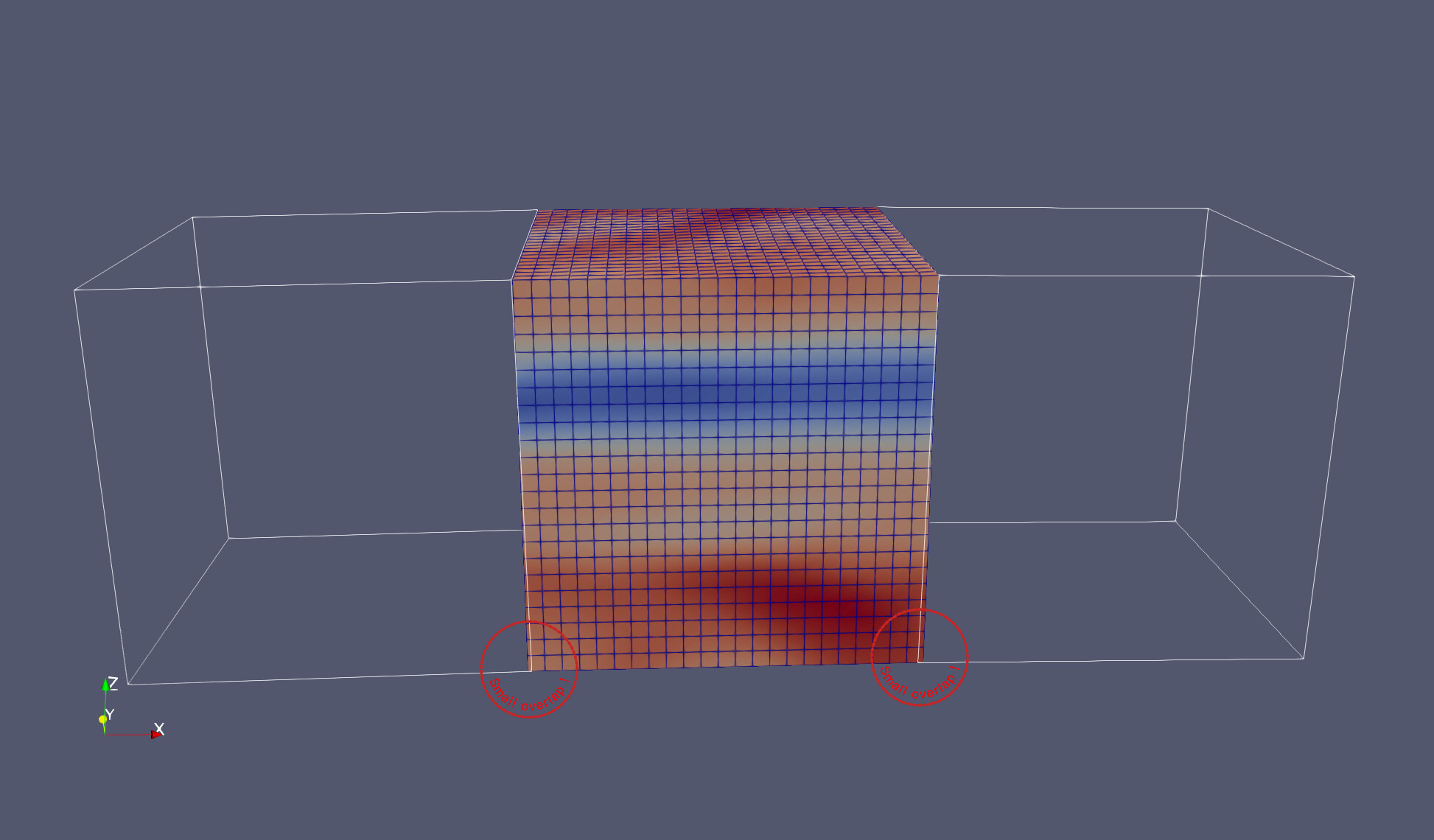
**Pipeline:** To visualise such a setup, I first convert all tiny meshes from native format to individual `*.vts` files using the **PyVista** `StructuredGrid()` & `save()` functions. Next, I manually write the content of the `*.vtm` file from the list of all the `*.vts` files. The content of this file looks something like this:
```auto
` to my `*.vts` but that made I/O even slower.
Any advice and guidance is welcome since, with every iteration, we are adding more and more small elements, and visualisation is more and more troublesome with the pipeline we have right now.
---
### Author:  [@nicolas.vuaille](https://discourse.paraview.org/u/nicolas.vuaille)
#### Post date: [September 18, 2023, 10:05am UTC](https://discourse.paraview.org/t/processing-very-large-vtkmultiblockdataset-performance-pipeline-suggestions-working-example-attached/12879/2 "2023-09-18T10:05:54Z")
Hi!
This is a really nice use case, thanks for sharing!
As you noted, the `MultiBlock` data structure does not have a good scaling.
I think grouping them into one unstructured grid is the way to go.
Some thoughts that come to my mind:
- For best I/O performance, you may want to have a look to the [vtk hdf](https://docs.vtk.org/en/latest/design_documents/VTKFileFormats.html#unstructured-grid) file format. You will need to write the file by yourself, though (no vtk hdf writer)
- otherwise, prefer `vtkXMLUnstructuredGridWriter` to create a `.vtu` file (over the `vtk` writer)
- If not already the case, a `RedistributeDataSet` filter as first pipeline item will ensure your load balancing.
---
### Author:  [@nicolas.vuaille](https://discourse.paraview.org/u/nicolas.vuaille)
#### Post date: [September 18, 2023, 11:34am UTC](https://discourse.paraview.org/t/processing-very-large-vtkmultiblockdataset-performance-pipeline-suggestions-working-example-attached/12879/3 "2023-09-18T11:34:50Z")
Oh, and in your aggregator script, instead of a `AppendDataSet`, you may try to use a `vtkGroupDataSetFilter` with `SetOutputTypeToPartitionedDataSet()` property.
Then you can write the result with `vtkXMLPartitionedDataSetWriter`.
This structure, similar to multiblock, may have a better performance scaling.
---
### Author:  [@utkarsh.ayachit](https://discourse.paraview.org/u/utkarsh.ayachit)
#### Post date: [September 18, 2023, 12:53pm UTC](https://discourse.paraview.org/t/processing-very-large-vtkmultiblockdataset-performance-pipeline-suggestions-working-example-attached/12879/4 "2023-09-18T12:53:08Z")
> [@nicolas.vuaille](#):
>
> - otherwise, prefer `vtkXMLUnstructuredGridWriter` to create a `.vtu` file (over the `vtk` writer)
> - If not already the case, a `RedistributeDataSet` filter as first pipeline item will ensure your load balancing.
@nicolas.vuaille , the dataset here is VTS, so a structured grid. I’d stay away from converting to unstructured grid (which is what both these would entail) to avoid unnecessary conversions and bloat (both memory and performance wise).
---
### Author:  [@nicolas.vuaille](https://discourse.paraview.org/u/nicolas.vuaille)
#### Post date: [September 18, 2023, 1:27pm UTC](https://discourse.paraview.org/t/processing-very-large-vtkmultiblockdataset-performance-pipeline-suggestions-working-example-attached/12879/5 "2023-09-18T13:27:57Z")
Indeed, I was focused on the suggested script that already converts to unstructured grid.
---
### Author:  [@M1kol4j](https://discourse.paraview.org/u/M1kol4j)
#### Post date: [September 18, 2023, 8:02pm UTC](https://discourse.paraview.org/t/processing-very-large-vtkmultiblockdataset-performance-pipeline-suggestions-working-example-attached/12879/6 "2023-09-18T20:02:53Z")
Dear @nicolas.vuaille and @utkarsh.ayachit, your comments put me on the right track and with a few changes to my pipeline, performance improved drastically. Here are things I have changed for those who might face similar problems:
**Stage 1 [from raw format to vtk]** It looks like saving structured grid via PyVista to `*.vtk` not `*.vts` is way faster. So, the first change I made is to use:
```auto
X,Y,Z = np.meshgrid(Xc,Yc,Zc) # Xc,Yc,Zc are axis after rotation for that titled cubes effect
# ... fill mesh
mesh = pyvista.StructuredGrid(X,Y,Z)
mesh.save("%s/%04d/%s_%d.vtk" % (work_dir,p.rank,snap_base_name,id))
```
Since our raw format stores data in a few easy-to-read binary files, saving too many `*.vtk` files can be easily done in parallel, and it takes around `150.0 [s]` to create 32k small `*.vtk` cubes of size `32^3` with 16 AMD EPYC cores.
**Stage 2 [many `*.vtk` to few `*.vtu`]** Since our data is from massive parallel simulation with well-balanced domain decomposition, each small mesh knows to which MPI rank it belongs. I have used that information to _fuse_ all (now vtk meshes) from the same rank into one `*.vtu` file. For that, I used the following code:
```auto
def combine2vtu(sub_dir): # one sub-dir per MPI rank with many *.vtk files in it
reader = vtkStructuredGridReader()
append = vtkAppendFilter()
filenames = glob.glob(sub_dir+'/VB6*.vtk')
for file in filenames:
reader.SetFileName(file)
reader.Update()
structured = vtkStructuredGrid()
structured.ShallowCopy(reader.GetOutput())
append.AddInputData(structured)
append.Update()
writer = vtkXMLUnstructuredGridWriter()
writer.SetFileName(sub_dir+'/output.vtu')
writer.SetInputData(append.GetOutput())
writer.Write()
# clean up
for file in filenames:
os.remove(file)
return True
```
Again, this can be done in parallel // `160s` for that `32k` elements fused into `24` `vtu` files on the same machine.
**Stage 3 [creating vtm file]**
Finally, I created the final `vtm` file with as many blocks as many MPI ranks we have used for a particular simulation.
```auto
with open(ffile_name, 'w') as f:
f.write("\n")
f.write("\n")
f.write("\t\n")
for rank in id_rank.keys():
f.write("\t\t\n" % rank)
master_file = "%s/%04d/output.vtu" % (work_dir,rank)
f.write("\t\t\t\n" % (snap_time,rank,master_file))
f.write("\t\t\n")
f.write("\t\n")
f.write("\n")
```
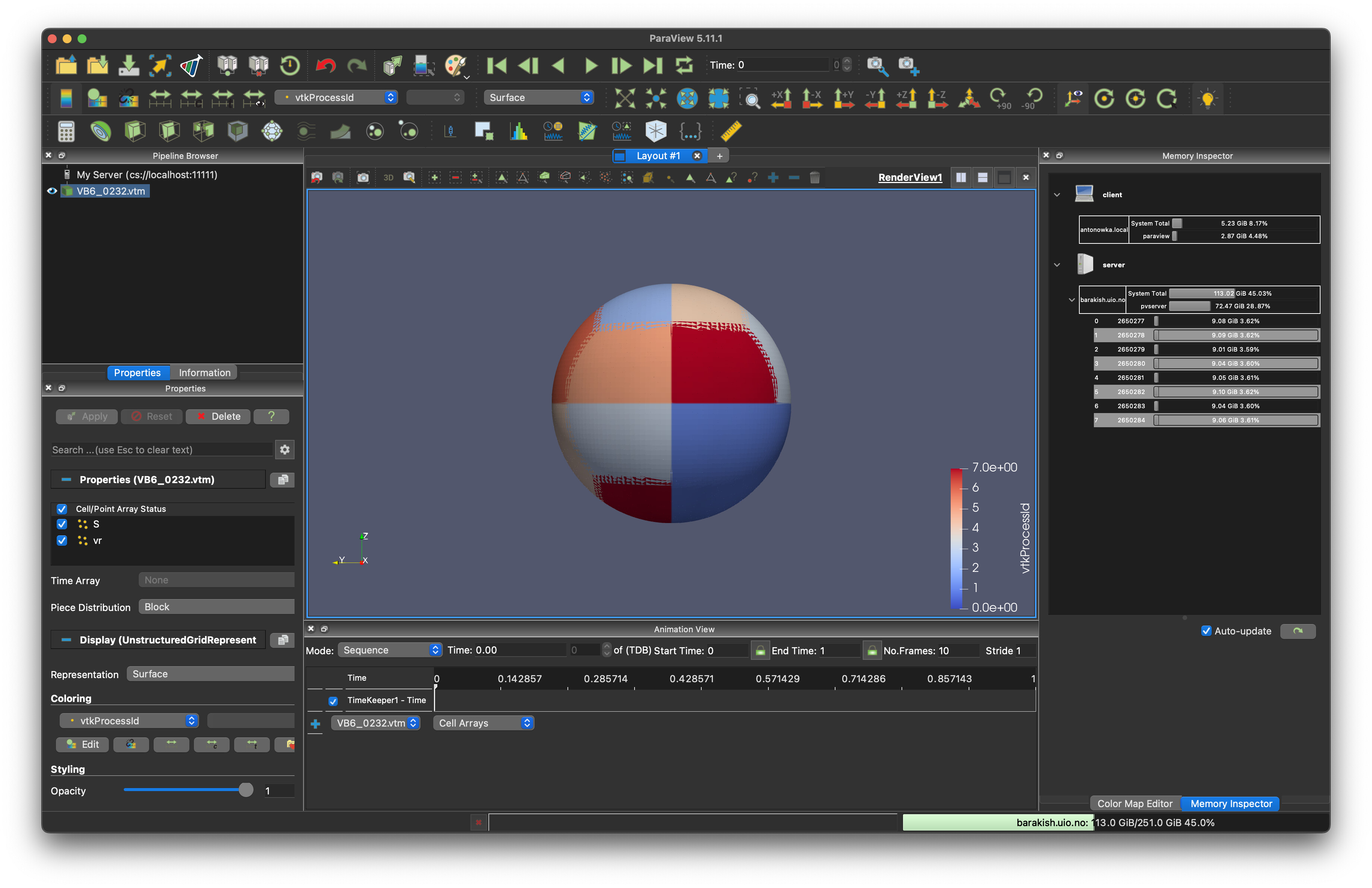
And this works perfectly! Both initial I/O and slicing work within seconds. Here is a screen with the final domain decomposition and memory footprint //Although this near-perfect load balancing is inherited from the domain decomposition of the simulation.
Of course, there is room for improvement; for instance, it would be great if I could somehow skip creating so many `*.vtk` files i.e., maybe there is a way to create appropriate vtk objects before passing them to `vtkXMLUnstructuredGridWriter()`?
Ideas comments?
---
### Author:  [@nicolas.vuaille](https://discourse.paraview.org/u/nicolas.vuaille)
#### Post date: [September 20, 2023, 9:16am UTC](https://discourse.paraview.org/t/processing-very-large-vtkmultiblockdataset-performance-pipeline-suggestions-working-example-attached/12879/7 "2023-09-20T09:16:12Z")
As far as I can see, pyvista object inherits from VTK one. So you can use your `mesh` object as a `vtkStructuredGrid` directly in `append.AddInputData`, without the `.vtk` I/O part.
Then, as Utkarsh stated, Unstructured Grid (i.e. the output of the `Append` filter) are the most generic data object we have and thus are the worst in term of memory and performance.
One way to explore to mitigate this is to use vtkExplicitStructuredGrid. As shown in this [blog post](https://www.kitware.com/introducing-explicit-structured-grids-in-vtk-and-paraview/), this is is a tradeoff between Structured and Unstructured data.
But this may be an optimization for the processing part, once in ParaView.