# Python - Slice Face two separate data sets
**URL:** https://discourse.paraview.org/t/python-slice-face-two-separate-data-sets/3876
**Category:** ParaView Support
**Created:** [March 24, 2020, 9:00pm UTC](https://discourse.paraview.org/t/python-slice-face-two-separate-data-sets/3876 "2020-03-24T21:00:00Z")
**Posts on this page:** 3
**Page:** 1
### Author:  [@chart3388](https://discourse.paraview.org/u/chart3388)
#### Post date: [March 24, 2020, 9:00pm UTC](https://discourse.paraview.org/t/python-slice-face-two-separate-data-sets/3876/1 "2020-03-24T21:00:00Z")
Hi All,
I have a thin surface with different values on the front and back face (front and back are just arbitrary names given for ease). We’d like to be able to separate the front face data and the back face data into two separate data sets to be used for interpolation. Generally speaking we want to be able to interpolate from one thin surface to another thin surface and preserve the different values on each side of the source.
Thoughts?
Thanks,
Corey
---
### Author:  [@utkarsh.ayachit](https://discourse.paraview.org/u/utkarsh.ayachit)
#### Post date: [March 24, 2020, 9:26pm UTC](https://discourse.paraview.org/t/python-slice-face-two-separate-data-sets/3876/2 "2020-03-24T21:26:27Z")
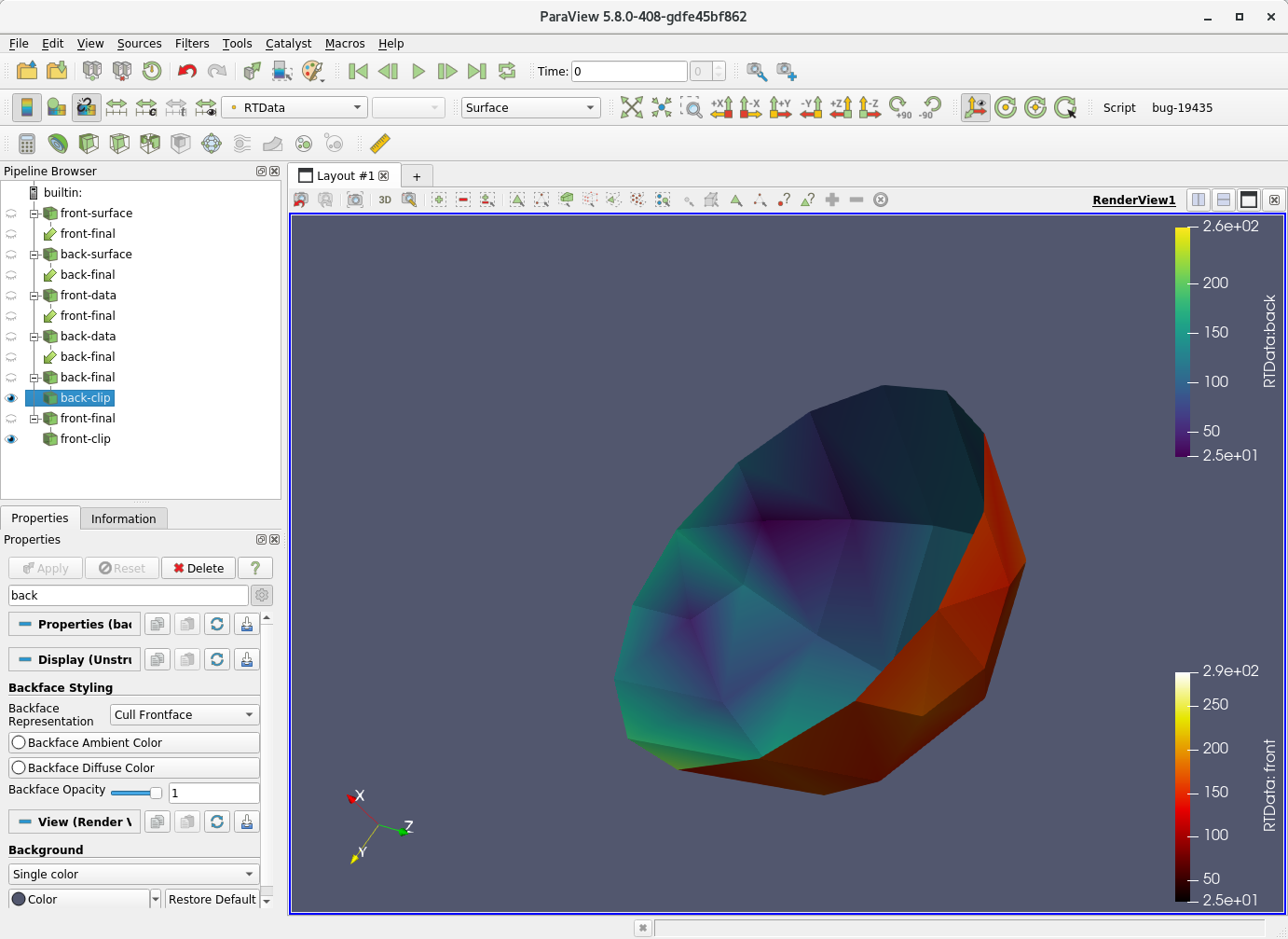
Generally speaking, this is not supported. ParaView doesn’t have concept of different fields for front and back. However, if you’re simply talking about rendering the results, you can do something as follows:
create independent pipelines for each of the front and back faces and then when you finally display them, you can change **Backface Representation** on the _Display Properties_ to be **Cull Backface** for the front-face representation and **Cull Frontface** for the backface representation.
Here’s an [state.pvsm](https://discourse.paraview.org/uploads/short-url/rvFFBAtSQlfTpu0aOMnueRIKijh.pvsm) (725.6 KB) that shows that with a Sphere. I created two different spheres and each using two different datasets providing scalars.
[/uploads/default/original/2X/b/b2660212c27353aec35d236223697cb1b71d4aa9.mp4](https://discourse.paraview.org/uploads/default/original/2X/b/b2660212c27353aec35d236223697cb1b71d4aa9.mp4)
---
### Author:  [@utkarsh.ayachit](https://discourse.paraview.org/u/utkarsh.ayachit)
#### Post date: [March 24, 2020, 9:33pm UTC](https://discourse.paraview.org/t/python-slice-face-two-separate-data-sets/3876/3 "2020-03-24T21:33:07Z")
here’s another state file [state-2.pvsm](https://discourse.paraview.org/uploads/short-url/1GIhJfLtuvmnCnO3pVE4wgnxlo8.pvsm) (1006.7 KB) , showing the effect more clearly.