# Unexpected behavior of MaxStepDistance in TemporalParticlesToPathlines
**URL:** https://discourse.paraview.org/t/unexpected-behavior-of-maxstepdistance-in-temporalparticlestopathlines/17643
**Category:** ParaView Support
**Created:** [June 30, 2026, 4:09pm UTC](https://discourse.paraview.org/t/unexpected-behavior-of-maxstepdistance-in-temporalparticlestopathlines/17643 "2026-06-30T16:09:25Z")
**Posts on this page:** 2
**Page:** 1
### Author:  [@anahitanaj](https://discourse.paraview.org/u/anahitanaj)
#### Post date: [June 30, 2026, 4:09pm UTC](https://discourse.paraview.org/t/unexpected-behavior-of-maxstepdistance-in-temporalparticlestopathlines/17643/1 "2026-06-30T16:09:25Z")
Hi everyone,
I am using **ParticleTracer** followed by **TemporalParticlesToPathlines** in ParaView 6.0 to visualize the pathlines in the blood vessels of the body using 4D flow MRI data.
I use:
_ForceReinjectionEveryNSteps = 1
a custom unique PathlineParticleId (combining ParticleId and InjectionStepId) as the IdChannelArray
MaskPoints = 2
MaxTrackLength = 3_
I initially expected a lower **MaxStepDistance** to remove unrealistic long jumps between particle positions, based on the documentation:
> “If a step occurs larger than the value, the track will be dropped and restarted after the step.”
However, I observe the opposite behavior.
In my example dataset, with **MaxStepDistance** = 20, many straight “bad stitch” lines appear across the vessel (see image below).
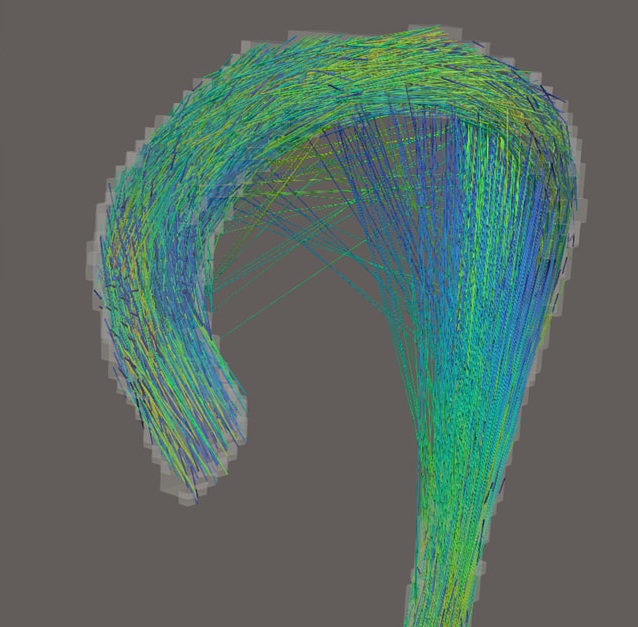
Increasing **MaxStepDistance** to 50 removes these artifacts and produces smooth pathlines:
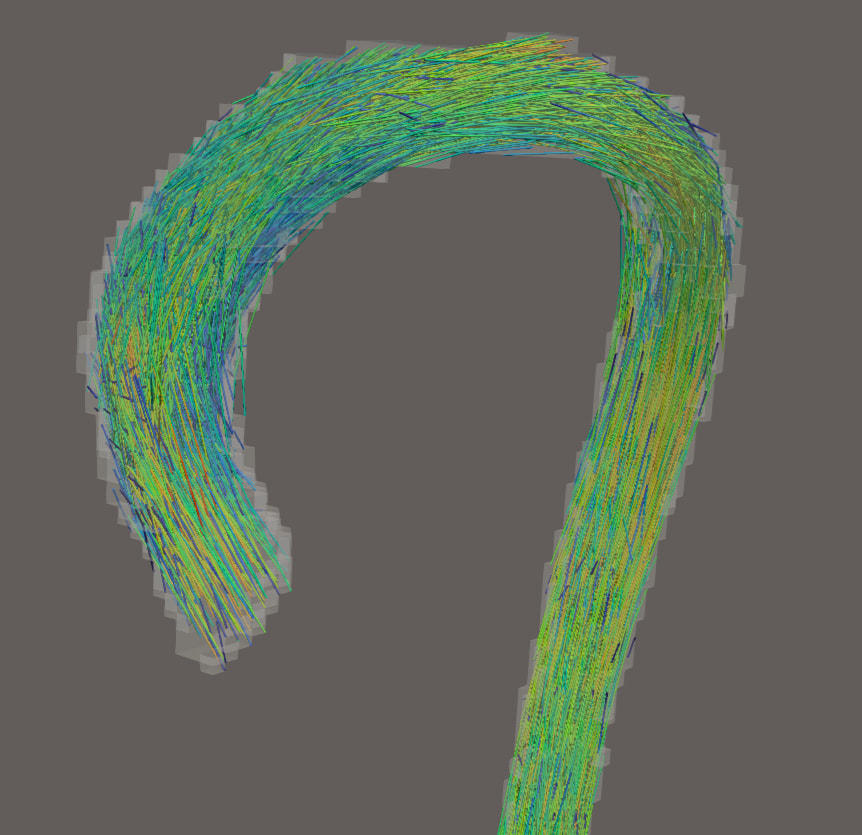
I verified that my custom IDs are unique, so this does not appear to be an ID problem.
My question is:
How is **MaxStepDistance** actually applied inside **TemporalParticlesToPathlines**? Specifically, why would decreasing the threshold counterintuitively create straight stitching artifacts, whereas increasing it removes them? Any insight into the implementation or intended behavior would be greatly appreciated.
---
### Author:  [@mwestphal](https://discourse.paraview.org/u/mwestphal)
#### Post date: [July 6, 2026, 4:08pm UTC](https://discourse.paraview.org/t/unexpected-behavior-of-maxstepdistance-in-temporalparticlestopathlines/17643/2 "2026-07-06T16:08:54Z")
> [@anahitanaj](#):
>
> **MaxStepDistance**
Here is the code:
```auto
if (trail->length > 0)
{
unsigned int lastindex = (this->MaxTrackLength + trail->lastpoint - 1) % this->MaxTrackLength;
double* lastcoord = trail->Coords[lastindex].x;
//
double distx = fabs(lastcoord[0] - coord[0]);
double disty = fabs(lastcoord[1] - coord[1]);
double distz = fabs(lastcoord[2] - coord[2]);
dist = sqrt(distx * distx + disty * disty + distz * distz);
//
if (distx > this->MaxStepDistance[0] || disty > this->MaxStepDistance[1] ||
distz > this->MaxStepDistance[2])
{
trail->alive = false;
trail->updated = true;
return;
}
}
```
It looks to me that if the dist is greater than max step distance, then the particle is killed.
Could you share data to reproduce ?