# VRML importer regression
**URL:** https://discourse.paraview.org/t/vrml-importer-regression/2382
**Category:** Development
**Tags:** vtk
**Created:** [August 8, 2019, 8:36pm UTC](https://discourse.paraview.org/t/vrml-importer-regression/2382 "2019-08-08T20:36:01Z")
**Posts on this page:** 6
**Page:** 1
### Author:  [@Lorensen](https://discourse.paraview.org/u/Lorensen)
#### Post date: [August 8, 2019, 8:36pm UTC](https://discourse.paraview.org/t/vrml-importer-regression/2382/1 "2019-08-08T20:36:01Z")
There is a regression between 4.1 and 5.0RC1.
Here is the 4.1
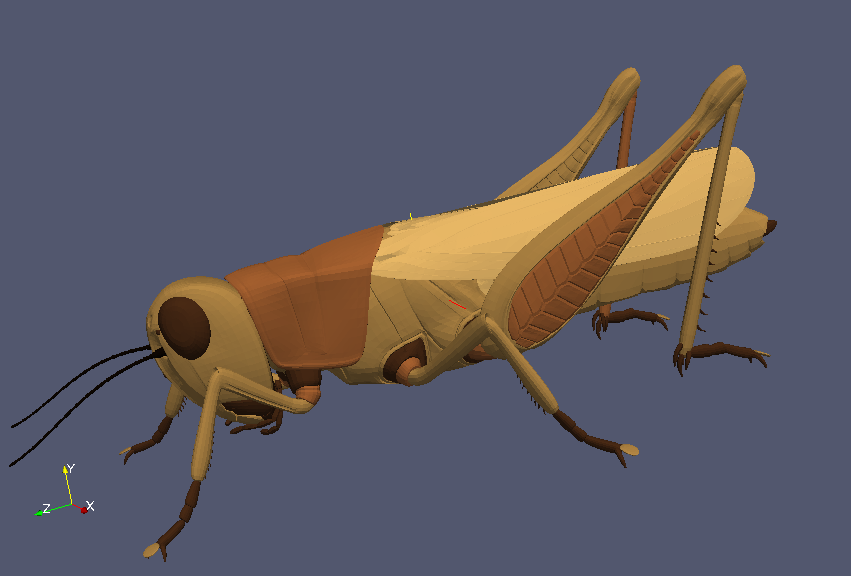 vs the 5.0rc1  .
The data I used is [here](https://github.com/lorensen/VTKExamples/raw/master/src/Testing/Data/grasshop.wrl).
---
### Author:  [@jourdain](https://discourse.paraview.org/u/jourdain)
#### Post date: [August 8, 2019, 9:03pm UTC](https://discourse.paraview.org/t/vrml-importer-regression/2382/2 "2019-08-08T21:03:55Z")
If you uncheck “Map Scalars” you get the expected rendering.
---
### Author:  [@Lorensen](https://discourse.paraview.org/u/Lorensen)
#### Post date: [August 8, 2019, 9:40pm UTC](https://discourse.paraview.org/t/vrml-importer-regression/2382/3 "2019-08-08T21:40:01Z")
Where do I find MapScalars?
---
### Author:  [@Lorensen](https://discourse.paraview.org/u/Lorensen)
#### Post date: [August 8, 2019, 9:41pm UTC](https://discourse.paraview.org/t/vrml-importer-regression/2382/4 "2019-08-08T21:41:20Z")
Found it! Thanks
---
### Author:  [@Lorensen](https://discourse.paraview.org/u/Lorensen)
#### Post date: [August 9, 2019, 2:43am UTC](https://discourse.paraview.org/t/vrml-importer-regression/2382/5 "2019-08-09T02:43:22Z")
Actually, it is a regression. In 4., MapScalars was off by default. Why was the default changed?
---
### Author:  [@cory.quammen](https://discourse.paraview.org/u/cory.quammen)
#### Post date: [August 9, 2019, 1:20pm UTC](https://discourse.paraview.org/t/vrml-importer-regression/2382/6 "2019-08-09T13:20:18Z")
4.0 and even 5.0rc1 is ancient history by now, so hard to recall exactly why the default was changed. My guess is that treating a 3-component array as a color array by default would be surprising for most datasets handled by ParaView, so that’s most likely the reason for the change.
We try not to change defaults when it can be avoided, and even provide a way for customers to save their own default settings when they don’t like ParaView’s. When we do change a default or remove parameters, we provide backwards compatibility support for older ParaView state files and even Python scripts. But when you are starting fresh, those mechanisms obviously don’t come into play.