# What does 'warp by vector' do exactly?
**URL:** https://discourse.paraview.org/t/what-does-warp-by-vector-do-exactly/14473
**Category:** ParaView Support
**Created:** [April 24, 2024, 5:27am UTC](https://discourse.paraview.org/t/what-does-warp-by-vector-do-exactly/14473 "2024-04-24T05:27:49Z")
**Posts on this page:** 5
**Page:** 1
### Author:  [@Yankang\_Liu](https://discourse.paraview.org/u/Yankang_Liu)
#### Post date: [April 24, 2024, 5:27am UTC](https://discourse.paraview.org/t/what-does-warp-by-vector-do-exactly/14473/1 "2024-04-24T05:27:49Z")
I want to get the exact definition of ‘the displacement vector’ in [the documentation](https://docs.paraview.org/en/latest/UsersGuide/filteringData.html).
Suppose I have a vector field \vec{v}(\vec{x}) defined on a domain \Omega. Does this filter add the displacement vector \vec{v}(\vec{x})-\vec{x} at each point \vec{x}. So literally it just relocates each point \vec{x}\in\Omega at \vec{v}.
---
### Author:  [@mwestphal](https://discourse.paraview.org/u/mwestphal)
#### Post date: [April 24, 2024, 9:56am UTC](https://discourse.paraview.org/t/what-does-warp-by-vector-do-exactly/14473/2 "2024-04-24T09:56:56Z")
Yes, this is exactly what it does.
---
### Author:  [@Yankang\_Liu](https://discourse.paraview.org/u/Yankang_Liu)
#### Post date: [April 24, 2024, 5:04pm UTC](https://discourse.paraview.org/t/what-does-warp-by-vector-do-exactly/14473/3 "2024-04-24T17:04:33Z")
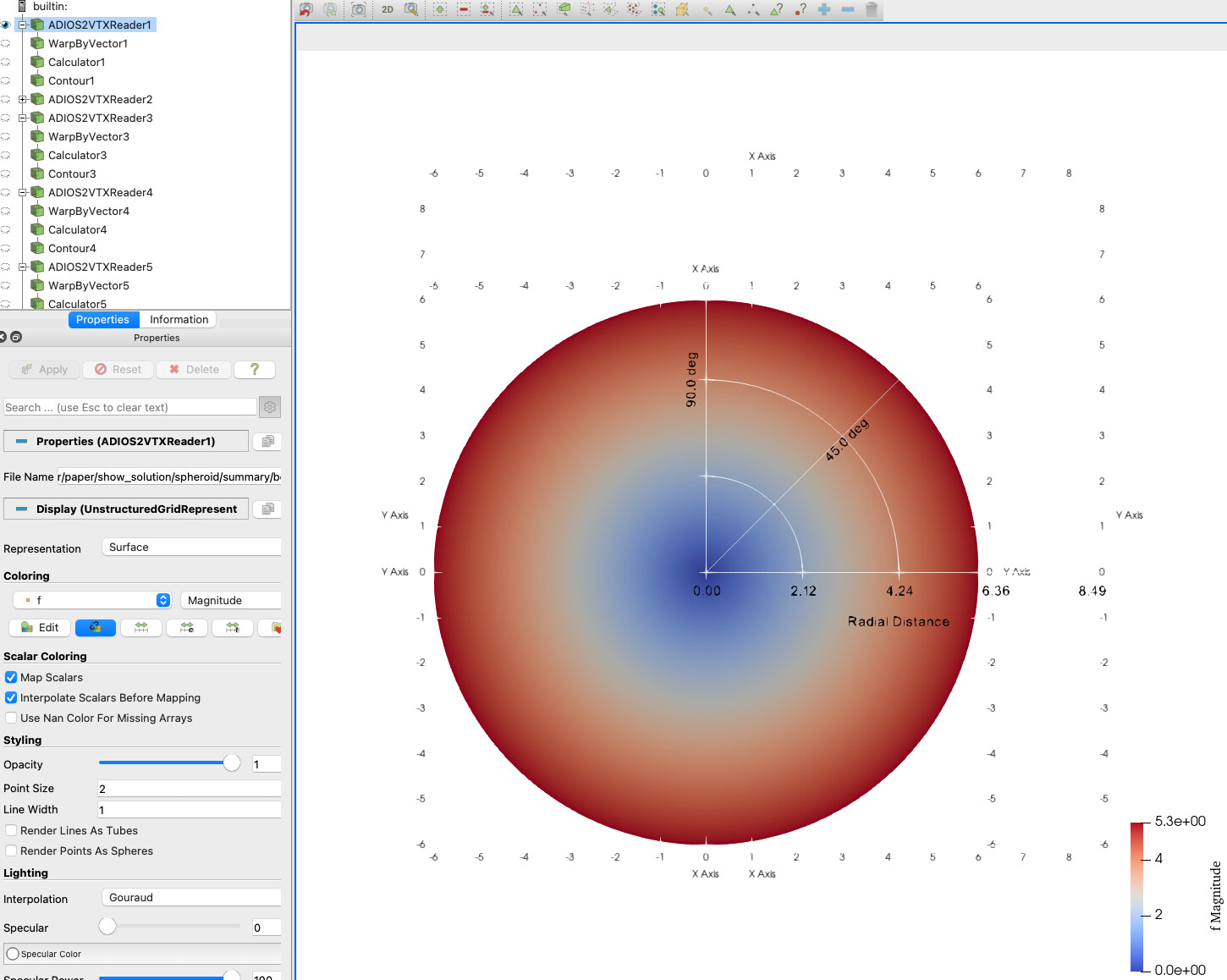
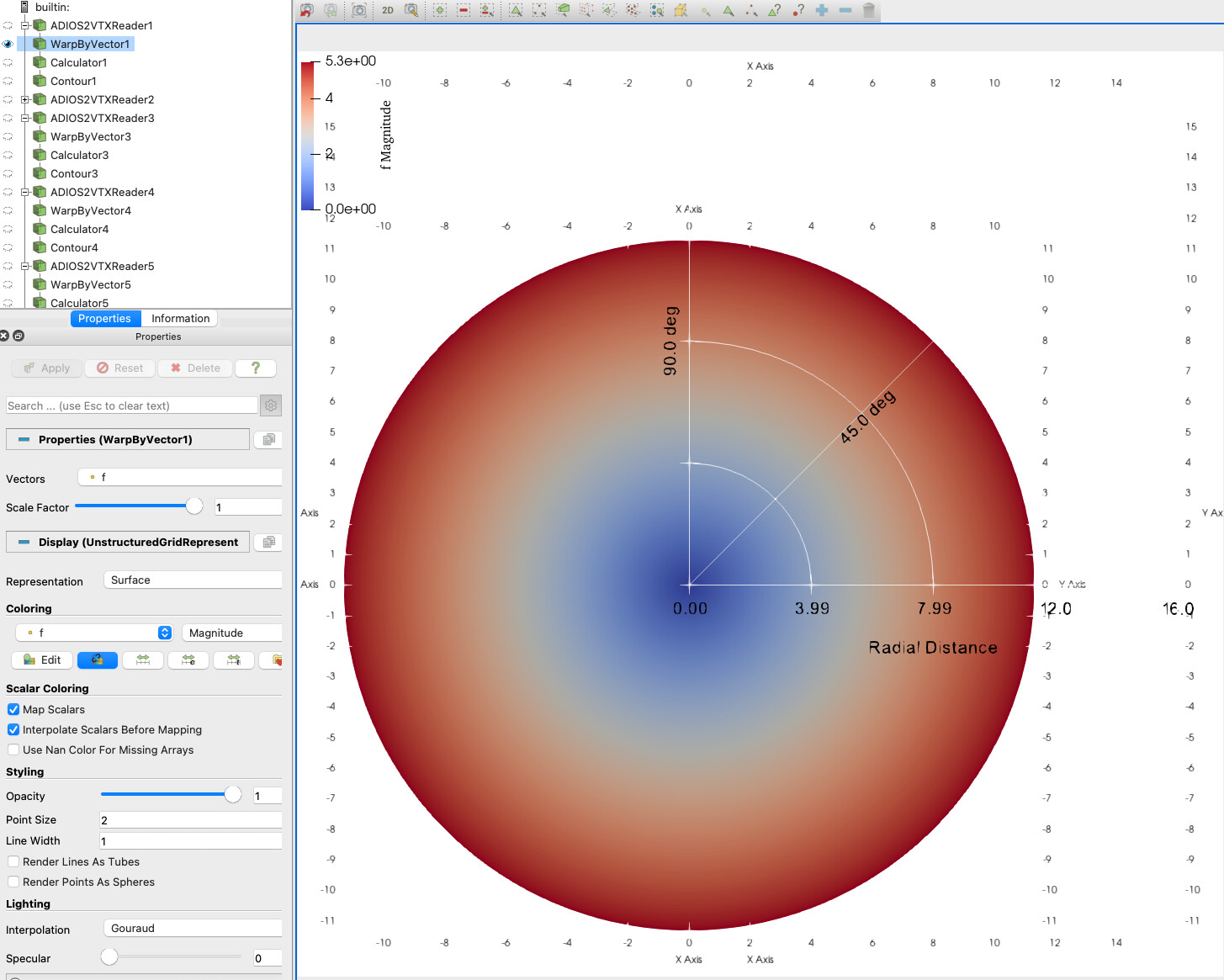
I have a circular domain and vector field on it as below. But somehow after ward the domain becomes much larger, which should be a little smaller if I understand… Can you tell how this happens? Or it actually adds \vec{v} instead of \vec{v}-\vec{x} to every points. The first figure is the original, the second is the warped.
---
### Author:  [@Yankang\_Liu](https://discourse.paraview.org/u/Yankang_Liu)
#### Post date: [April 24, 2024, 7:04pm UTC](https://discourse.paraview.org/t/what-does-warp-by-vector-do-exactly/14473/4 "2024-04-24T19:04:02Z")
I think the function of this filter is to displace the points by the assigned vector. That is to relocate each point \vec{x} by \vec{x}+\vec{v}. To get the ‘displacement’ in the context of elasticity theory, one has to use the calculator to create the displacement vector first, then warp.
---
### Author:  [@mwestphal](https://discourse.paraview.org/u/mwestphal)
#### Post date: [April 25, 2024, 6:46am UTC](https://discourse.paraview.org/t/what-does-warp-by-vector-do-exactly/14473/5 "2024-04-25T06:46:16Z")
Yes, that is correct.