# Young's Material Interface
**URL:** https://discourse.paraview.org/t/youngs-material-interface/2875
**Category:** ParaView Support
**Created:** [October 29, 2019, 9:53pm UTC](https://discourse.paraview.org/t/youngs-material-interface/2875 "2019-10-29T21:53:49Z")
**Posts on this page:** 18
**Page:** 1
### Author:  [@wascott](https://discourse.paraview.org/u/wascott)
#### Post date: [October 29, 2019, 9:53pm UTC](https://discourse.paraview.org/t/youngs-material-interface/2875/1 "2019-10-29T21:53:49Z")
I have a user that is trying to figure out the Young’s Material Interface filter. Is this documented anywhere, or who is our resident expert? Could someone give me an example using this filter?
Thanks! Alan.
---
### Author:  [@randomwangran](https://discourse.paraview.org/u/randomwangran)
#### Post date: [February 17, 2020, 2:53am UTC](https://discourse.paraview.org/t/youngs-material-interface/2875/2 "2020-02-17T02:53:35Z")
what is young’s material interface?
---
### Author:  [@mwestphal](https://discourse.paraview.org/u/mwestphal)
#### Post date: [February 17, 2020, 3:23am UTC](https://discourse.paraview.org/t/youngs-material-interface/2875/3 "2020-02-17T03:23:21Z")
> **[Youngs Material Interface Reconstruction with VTK and ParaView - Kitware Blog](https://blog.kitware.com/youngs-material-interface-reconstruction-with-vtk-and-paraview/)**
>
> This blog entry is the last in a series of three articles reporting on the results of our ongoing collaboration with Commissariat à l’Energie Atomique ... Read More
[https://vtk.org/doc/nightly/html/classvtkYoungsMaterialInterface.html](https://vtk.org/doc/nightly/html/classvtkYoungsMaterialInterface.html)
Quite a specialized tool though.
---
### Author:  [@randomwangran](https://discourse.paraview.org/u/randomwangran)
#### Post date: [February 17, 2020, 3:44am UTC](https://discourse.paraview.org/t/youngs-material-interface/2875/4 "2020-02-17T03:44:00Z")
> The vtkYoungsMaterialInterface filter reconstructs material interfaces from a mesh containing mixed cells (i.e., a mesh where several materials are or can be mixed within each individual cell).
> > mesh where several materials are or can be mixed within each individual cell
> > > mesh mixed within each individual cell?
Does it mean different component?
Like modeling a car. You have bumper, you have seat.
Then you reconstruct them?
---
### Author:  [@mwestphal](https://discourse.paraview.org/u/mwestphal)
#### Post date: [February 17, 2020, 3:46am UTC](https://discourse.paraview.org/t/youngs-material-interface/2875/5 "2020-02-17T03:46:21Z")
@utkarsh.ayachit
---
### Author:  [@Xueyi\_Bao](https://discourse.paraview.org/u/Xueyi_Bao)
#### Post date: [October 25, 2021, 1:01pm UTC](https://discourse.paraview.org/t/youngs-material-interface/2875/6 "2021-10-25T13:01:52Z")
Hi, I have a project recently that could use Youngs Material interface reconstruction filter in Paraview.
I have two .vti files that only encode the density of each fluid. How can I apply Youngs fiter to reconstruct interface between this two fluids?
I tried to use group data set filter to get a multiblock data set, but the Youngs filter is still grey and can’t be applied to it.
I would really appreciate it if you can provide some instructions. :grinning
---
### Author:  [@mwestphal](https://discourse.paraview.org/u/mwestphal)
#### Post date: [October 25, 2021, 3:17pm UTC](https://discourse.paraview.org/t/youngs-material-interface/2875/7 "2021-10-25T15:17:07Z")
FYI @timothee.chabat
---
### Author:  [@timothee.chabat](https://discourse.paraview.org/u/timothee.chabat)
#### Post date: [October 25, 2021, 3:35pm UTC](https://discourse.paraview.org/t/youngs-material-interface/2875/8 "2021-10-25T15:35:35Z")
You’re in the right track, you indeed have to group both datasets into a single multiblock before anything.
Each of your datasets should contain an array representing the volume fraction of the volume into the cell. Also to have a nicer result you can have a data array describing the normal at the surface of your interface for each cell.
In the property of the youngMaterialInterface filter, in the volume fraction array table property, only toggle the volume fraction arrays describing your volumes. Then for each array you toggled, select it and set the normal array corresponding to this material if you have one (just below the table). Untoggle every other option first and apply, then you can play around to see what the other options do.
---
### Author:  [@Xueyi\_Bao](https://discourse.paraview.org/u/Xueyi_Bao)
#### Post date: [October 25, 2021, 7:53pm UTC](https://discourse.paraview.org/t/youngs-material-interface/2875/9 "2021-10-25T19:53:21Z")
Thank you!
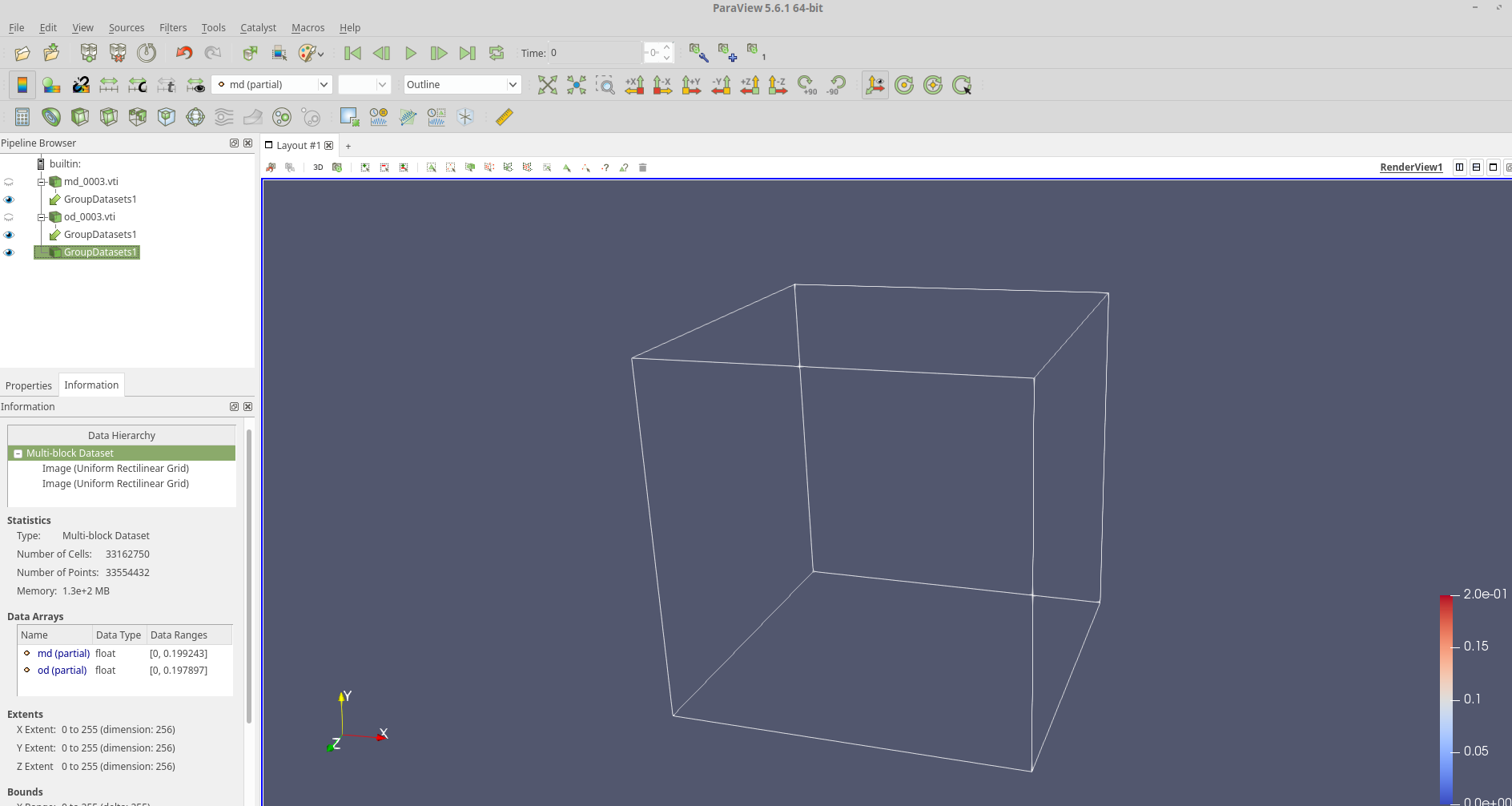
I am still having this problem after I group the two .vti data sets. The Young’s filter is still dark.
I must have missed something.
---
### Author:  [@timothee.chabat](https://discourse.paraview.org/u/timothee.chabat)
#### Post date: [October 26, 2021, 8:13am UTC](https://discourse.paraview.org/t/youngs-material-interface/2875/10 "2021-10-26T08:13:37Z")
No idea so far, it’s a pretty hard filter to use I concede. This is hard to tell what’s going on since your screenshot doesn’t tell much. Could you please share either some screenshots about the properties you set on the young interface filter and how your 2 vti looks like before you group them, or the data and a state file of the pipeline your building (if your data can be shared) ?
---
### Author:  [@Xueyi\_Bao](https://discourse.paraview.org/u/Xueyi_Bao)
#### Post date: [October 26, 2021, 3:03pm UTC](https://discourse.paraview.org/t/youngs-material-interface/2875/11 "2021-10-26T15:03:46Z")
Sure, I can share the datasets. Below is the link to the folder. It contains two .vti files encoding the oil and water density from Lattice Boltzmann simulation.
[https://drive.google.com/drive/folders/1vl-5cPyrYUFeGV3qULRlKsruo1Hknq4e?usp=sharing](https://drive.google.com/drive/folders/1vl-5cPyrYUFeGV3qULRlKsruo1Hknq4e?usp=sharing)
Thank you!
---
### Author:  [@timothee.chabat](https://discourse.paraview.org/u/timothee.chabat)
#### Post date: [October 26, 2021, 4:59pm UTC](https://discourse.paraview.org/t/youngs-material-interface/2875/12 "2021-10-26T16:59:11Z")
Ok you were missing a `Point Data To Cell Data` filter as the young material filter does not work on point but cell data. Here’s the pipeline I used (pvsm file) to have the result I screenshoted :
[young\_material\_interface.pvsm](https://discourse.paraview.org/uploads/short-url/wRbiitKIIpnhsH6n1oSt6JahQO7.pvsm) (912.4 KB)
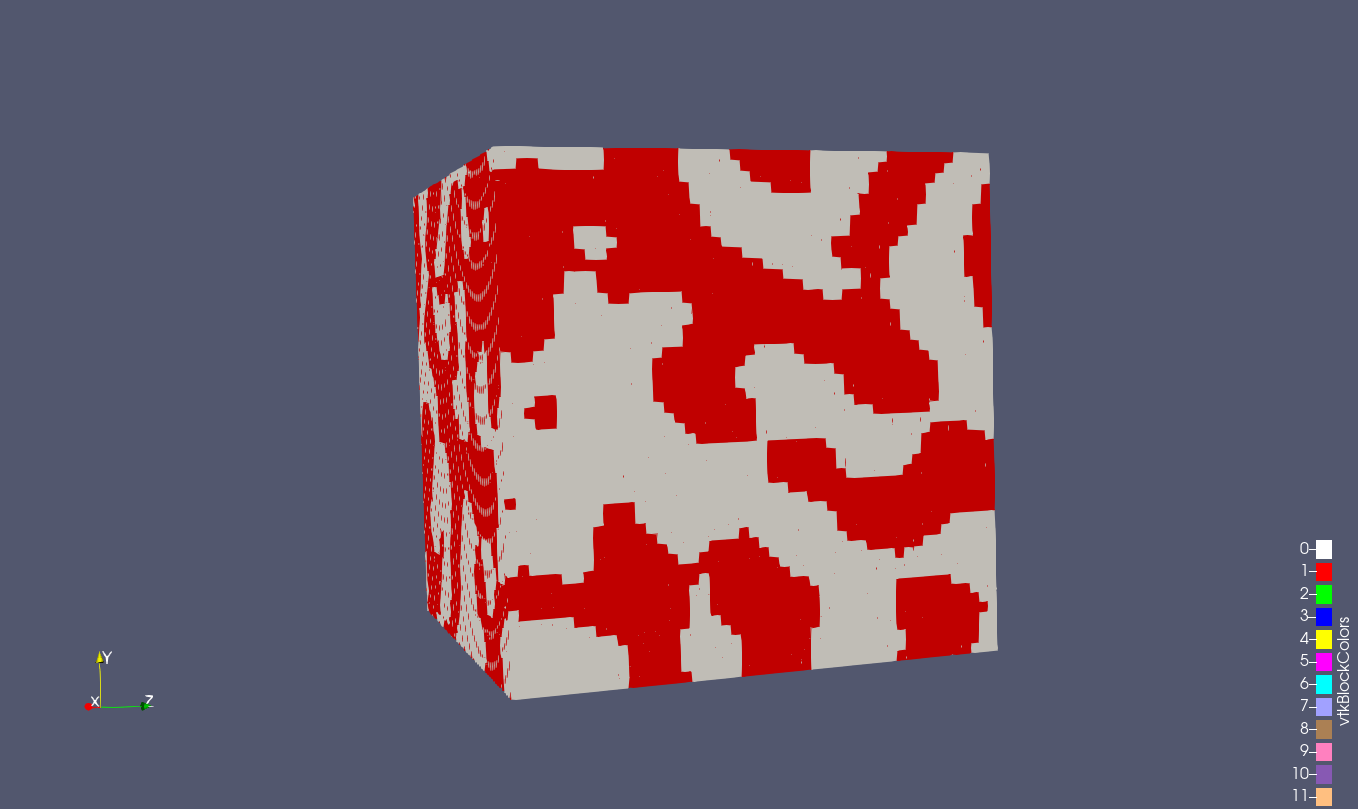
I also downsampled the dataset because otherwise it would take too long to compute on my computer but feel free to remove the `Resample To Image` filters in the pipeline if you want to.
Also the result isn’t so nice because your datasets does not contains any normal array describing the normal at the interface. If you have this data somewhere this would greatly improve the result.
---
### Author:  [@Xueyi\_Bao](https://discourse.paraview.org/u/Xueyi_Bao)
#### Post date: [October 26, 2021, 7:13pm UTC](https://discourse.paraview.org/t/youngs-material-interface/2875/13 "2021-10-26T19:13:03Z")
Thank you so much!
Sorry I don’t have any normal information.
The results seem OK. I just want to compare results from some representative interface reconstruction algorithms for research purpose. **Young’s** method is exactly one of them.
Also, do you know how I can write **material** information into **vtk** files? In that way I can load the file into **Visit.** I know **Visit** has implemented some interface reconstruction methods.
**Visit** support **vtk** files except that the material information has to be declared explicitly in some way to run those methods.
Anyway, thank you again for your help!
---
### Author:  [@timothee.chabat](https://discourse.paraview.org/u/timothee.chabat)
#### Post date: [October 27, 2021, 7:25am UTC](https://discourse.paraview.org/t/youngs-material-interface/2875/14 "2021-10-27T07:25:57Z")
The young material interface outputs a multi block and each block correspond to one of the material (more or less, I’ll let you check the result 🙂 ). So you could either directly export the multi block, or use the filter `Block Scalars` and then group all of the blocks using `Merge Blocks`. The material information will be the block id.
Other than that I don’t know how robust the young material algorithm is since it has not been developed by Kitware, just to keep in mind.
---
### Author:  [@Xueyi\_Bao](https://discourse.paraview.org/u/Xueyi_Bao)
#### Post date: [October 28, 2021, 6:43pm UTC](https://discourse.paraview.org/t/youngs-material-interface/2875/15 "2021-10-28T18:43:25Z")
Thank you Timothee for the information!
best,
---
### Author:  [@Xueyi\_Bao](https://discourse.paraview.org/u/Xueyi_Bao)
#### Post date: [October 28, 2021, 7:03pm UTC](https://discourse.paraview.org/t/youngs-material-interface/2875/16 "2021-10-28T19:03:11Z")
I have one additional question. After I apply the Young’s filter. How can I extract the exact interface (with inside materials filtered out)
thanks,
---
### Author:  [@timothee.chabat](https://discourse.paraview.org/u/timothee.chabat)
#### Post date: [November 2, 2021, 7:53am UTC](https://discourse.paraview.org/t/youngs-material-interface/2875/17 "2021-11-02T07:53:53Z")
You have to make sure the `Fill Material` property is unchecked and hit Apply again, in this case the filter will only output the interface. Also use `View` → `Multi Block Inpsector` to inspect your output and toggle visiblity for each of your blocks.
---
### Author:  [@Xueyi\_Bao](https://discourse.paraview.org/u/Xueyi_Bao)
#### Post date: [November 2, 2021, 5:19pm UTC](https://discourse.paraview.org/t/youngs-material-interface/2875/18 "2021-11-02T17:19:28Z")
Got it!